
Review · UK
Royal Observatory Greenwich & Prime Meridian Entrance Ticket
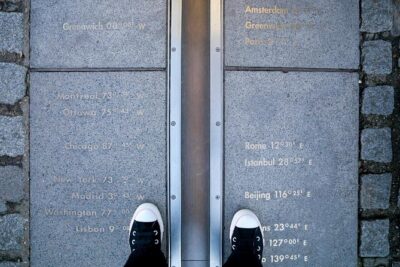
The main attraction is wonderfully simple: stand with one foot in the Eastern Hemisphere and one in the Western Hemisphere at Greenwich’s famous Prime Meridian. Then look out over Greenwich Park and the Thames from one of London’s best hilltop viewpoints.
I like the mix of big ideas and real objects here. You can trace how astronomers measured the stars, see John Harrison’s ingenious marine clocks, and step into the Octagon Room, a fine Christopher Wren interior. The drawback is the steep walk up from the park and nearby transport stops, which can be tiring if hills are difficult for you.
Key points to know
- The Prime Meridian is the star attraction: Stand at longitude zero and take the classic two-hemisphere photograph.
- Flamsteed House feels genuinely historic: See the Octagon Room, designed by Christopher Wren, along with rooms linked to royal astronomers.
- John Harrison’s clocks tell the best human story: His work helped solve the dangerous problem of finding longitude at sea.
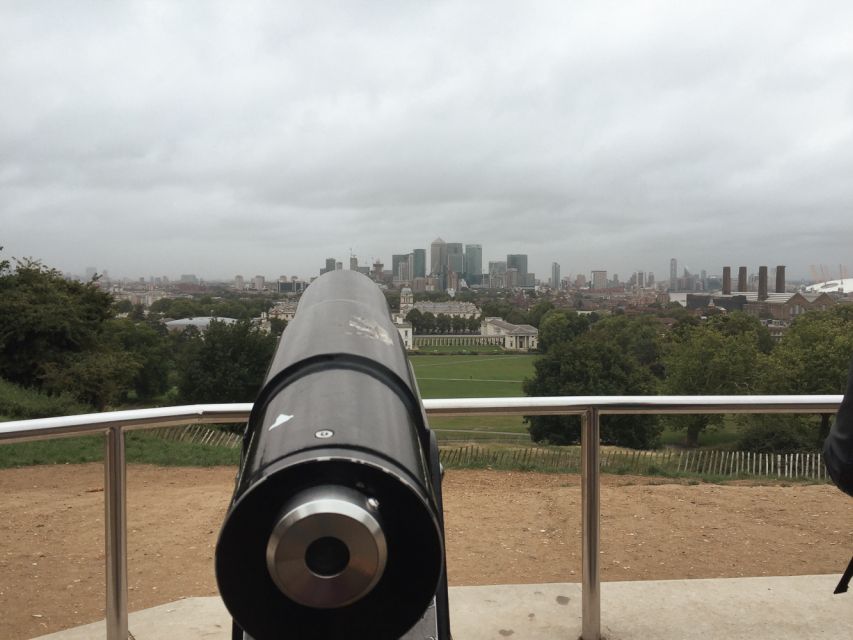
- The views justify the uphill walk: Greenwich Park, the River Thames, Canary Wharf, and the City of London spread out below.
- This is a self-guided visit: A downloadable audio guide is available in eight languages, but a live guide is not included.
- The planetarium costs extra: You can add a show at the observatory, but it is not part of this entrance ticket.
Why the Prime Meridian matters
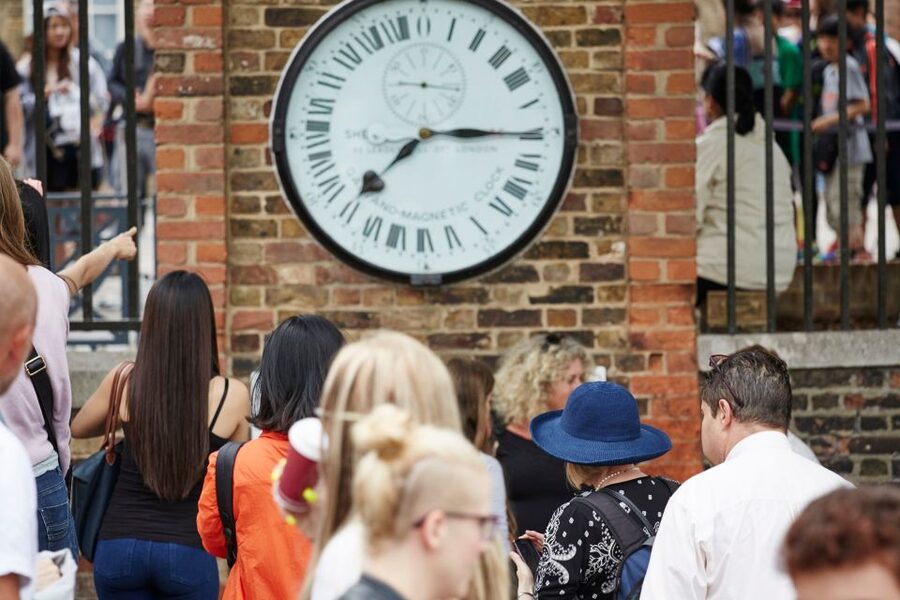
The brass line outside the observatory looks modest. Its meaning is not. This is the reference point from which longitude east or west was traditionally measured, and it helped give the world a common system for mapping time and place.
The Greenwich Meridian was selected as the world’s Prime Meridian in 1884. Before modern navigation systems, accurate longitude was a serious problem. Sailors could estimate latitude by observing the sun and stars, but knowing how far east or west they had sailed was much harder.
That practical problem gives the observatory its purpose. You are not simply looking at an old scientific building. You are visiting a place where astronomy, navigation, clocks, and international standards came together.
The photo opportunity is still the most obvious pleasure. Put one foot on each side of the line, then take a moment to notice what you are actually seeing. It is a symbolic dividing line, not a physical split in the ground, but it represents a system that shaped maps, sea travel, and timekeeping across the world.
Expect a small crowd around the line at busy times. The display is popular with families, school groups, and anyone who enjoys a good geographical oddity. It is quick to see, so do not make it the only reason for your visit.
More Observatory Visits in the world:
- Griffith Observatory Hike: Guided Tour through Griffith Park
★ 5.0 · 1,020 reviews - Tenerife: Mount Teide Observatory Guided Tour
★ 4.6 · 818 reviews - Los Angeles: Hollywood Night Tour with Griffith Observatory
★ 4.2 · 531 reviews
Walking up through Greenwich Park
The Royal Observatory sits at the top of a hill inside Greenwich Park. The approach is part of the experience, but you should plan for it rather than treat it as a minor detail.
From the park entrance, the route climbs steadily. From the Cutty Sark area and river pier, the hill feels particularly noticeable. The setting is beautiful, and the walk gives you a gradual reveal of the observatory and the view beyond it, but it is not ideal for anyone who finds steep paths difficult.
I would allow extra time for the climb, especially after arriving from Heathrow or central London with luggage or tired legs. Signs from Cutty Sark Station can be confusing, so check your route before setting off. Greenwich’s mainline station may be a more convenient choice for some journeys, although your best route depends on where you begin.
The hill is also why the visit works well as part of a larger Greenwich day. You can take your time in the park, visit the National Maritime Museum, see the Cutty Sark, and explore the shops around Greenwich rather than racing up and back for one photograph.
The activity is listed as wheelchair accessible, but the steep approach deserves careful thought. Accessibility at the entrance does not remove the challenge of reaching the building. If a hill is a concern, check the current access arrangements before booking and allow more time.
Flamsteed House and the Octagon Room
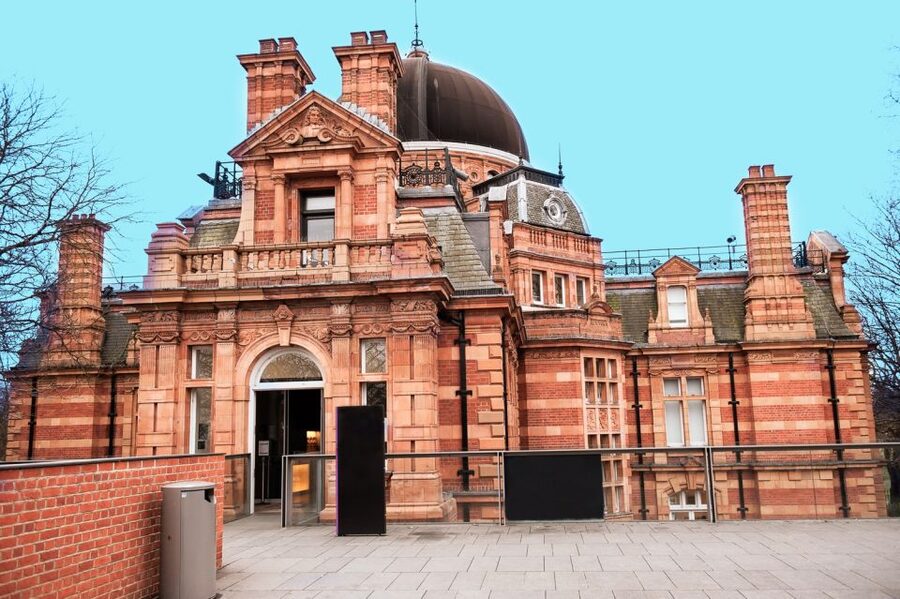
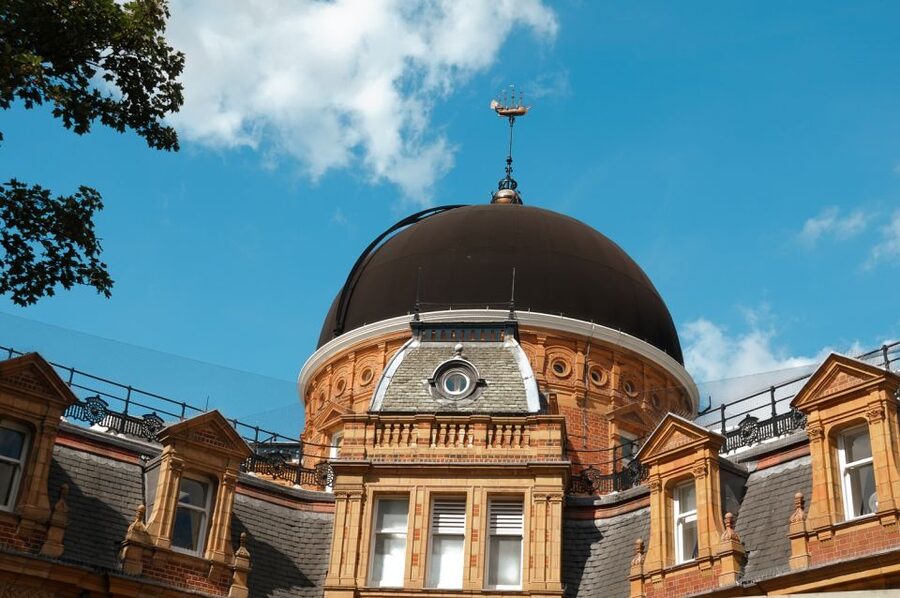
Flamsteed House is the historic heart of the visit. Built as the first purpose-made observatory in Britain, it is linked with the royal astronomers who worked to improve the accuracy of star charts and navigation.
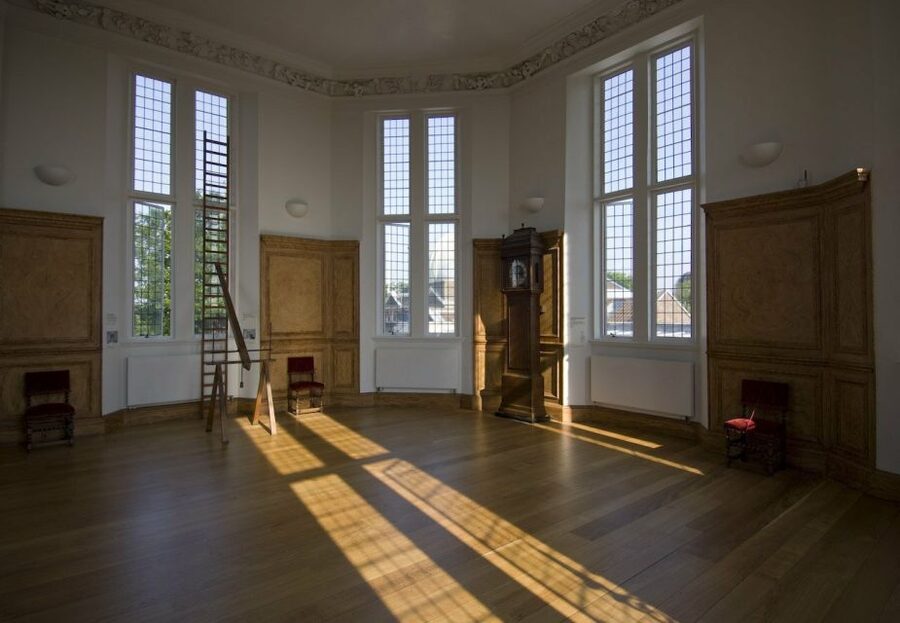
The Octagon Room is the highlight of this section. Sir Christopher Wren designed it, and the interior remains one of his best-preserved London interiors. Its tall windows and carefully proportioned space make it feel less like a modern museum room and more like a working place of science from another age.
Here, the story is about observation and patience. Astronomers had to record the movement of stars with great care, then compare those observations over time. Their work was slow by modern standards, but the consequences were enormous.
You will also encounter rooms connected with the astronomers associated with Greenwich, including Edmond Halley, James Bradley, Isaac Newton, George Airy, and John Harrison. The ticket does not include a personal guide, so you will get the most from the visit if you read the displays or use the downloadable audio material.
The multilingual guide is available in English, Spanish, Chinese, French, German, Italian, Korean, and Portuguese. It lets you move at your own pace, which is useful in the older rooms where space can feel limited. You can pause when a display catches your attention instead of keeping up with a group.
John Harrison’s clocks and the problem of longitude
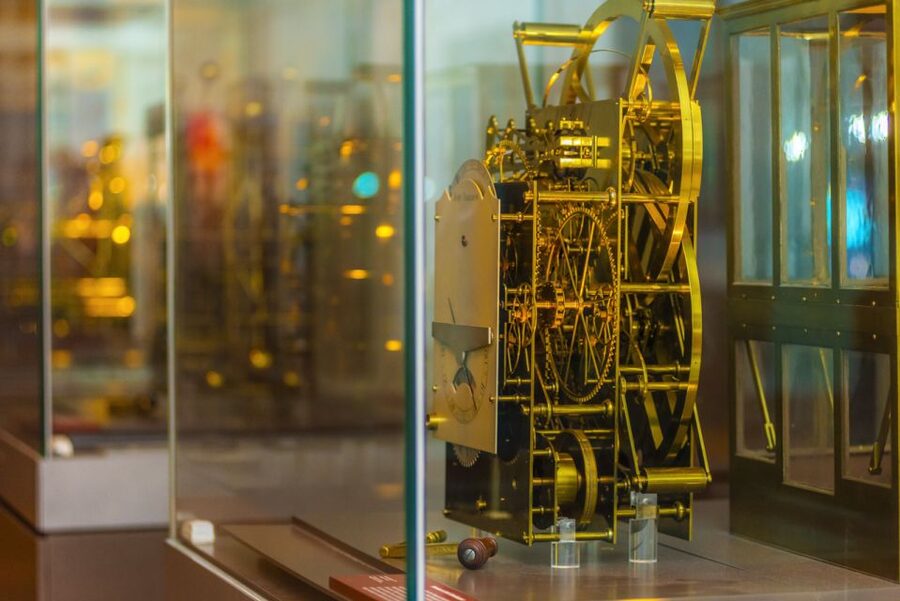
For me, the strongest historical story at Greenwich is John Harrison’s attempt to solve longitude at sea. It gives the visit a human face.
A clock loses or gains time as it encounters changing temperatures, motion, and humidity. At sea, even a small error could lead a ship far from its intended position. Harrison developed marine timekeepers designed to remain accurate during long voyages, giving sailors a reliable way to calculate their position east or west.
The clocks are impressive as objects, but the display becomes more interesting when you understand the stakes. This was not just a contest to build a clever machine. Better timekeeping could save ships, cargo, and lives.
Take your time here. The mechanism and design details reward close attention, especially if you like engineering, navigation, or stories about stubborn problem solving. Younger visitors may find the clocks more approachable than a long explanation of astronomical measurement because the objects make the challenge easier to picture.
The observatory also connects this work to figures such as Newton, Halley, Bradley, and Airy. You get a sense of science as a chain of experiments, arguments, improvements, and occasional failures rather than a neat series of finished discoveries.
More Entry Tickets in the world:
- Miami: Frost Museum of Science and Planetarium Entry Ticket
★ 4.5 · 429 reviews - Royal Observatory Greenwich & Prime Meridian Entry Ticket London
★ 4.0 · 367 reviews - Houston Museum of Natural Sciences: Planetarium Ticket
★ 4.5 · 139 reviews - Jasper: Jasper Planetarium and Telescope Combo Tour Tickets
★ 3.8 · 118 reviews
Astronomy Centre and the meteorite
The modern Astronomy Centre changes the pace. After the old rooms and historic instruments, you move toward displays about space and the wider universe.
One unusual feature is the chance to touch a meteorite estimated to be 4.5 billion years old. That is the kind of small physical encounter that can make a science visit memorable. You are not only reading about the age of the solar system. You are placing a hand on a piece of material that has existed for an almost unimaginable span of time.
The Astronomy Centre is a good reason to include teenagers in the visit. The observatory is not only about old buildings and longitude lines. It connects navigation and timekeeping with astronomy, planetary science, and the question of how we understand space.
Do not expect this entrance ticket to include a planetarium show. The Peter Harrison Planetarium offers a separate experience, and you need to buy a show ticket independently. If you want a timed film or presentation about the universe, check availability before your visit rather than assuming it comes with admission.
The planetarium can be a useful add-on, but it changes the schedule. The observatory itself can be explored at your own pace, while a planetarium presentation requires you to arrive at a set time. Families should decide if they want the flexibility of the main visit or the added structure of a show.
The London view from the hilltop
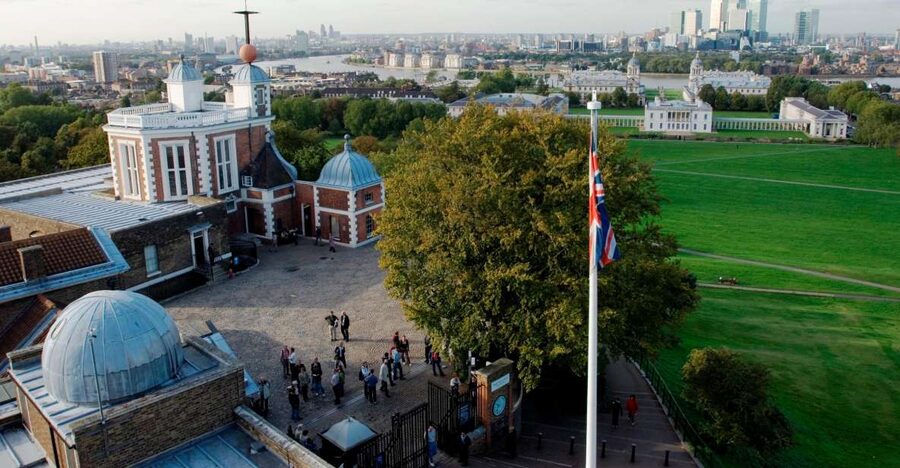
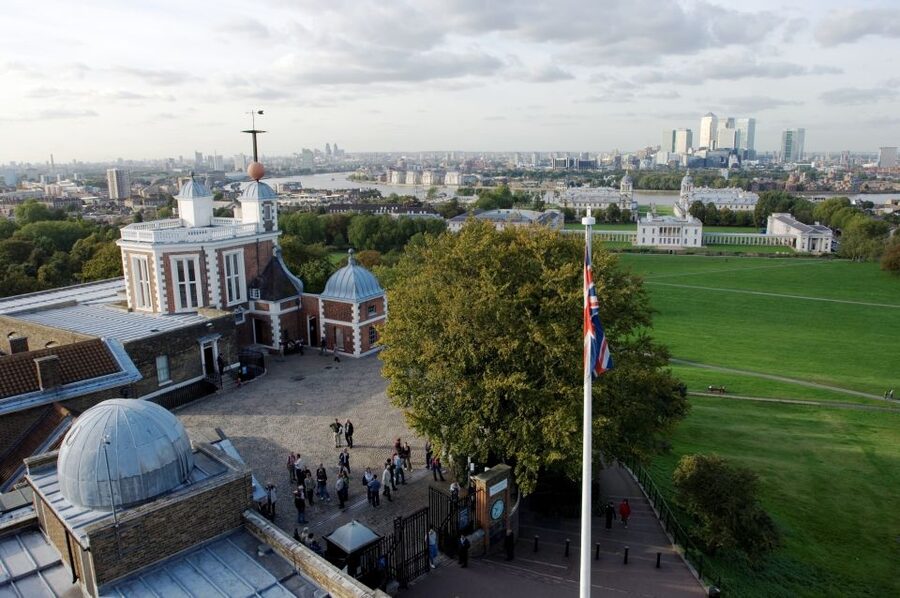
The view is not a side attraction. It is one of the best reasons to come.
From the observatory, Greenwich Park falls away toward the River Thames. On a clear day, you can pick out the City of London and Canary Wharf, with the river winding through the middle distance. The view helps explain why this location mattered. The observatory had room, height, and a clear setting for watching the sky.
I like visiting the viewpoint after the indoor exhibits. The older rooms can feel focused and detailed, while the view gives you space to step back and understand Greenwich as a whole.
Bring time for photographs, but also look beyond the standard skyline shot. The park itself is part of the pleasure, and the changing relationship between the formal grounds, the river, and modern London gives the visit a pleasing contrast.
Weather matters here. Clouds can reduce the skyline to a gray outline, while clear conditions make the climb feel especially worthwhile. The indoor displays still give you a solid visit on a dull day, but the view is at its best when the air is clear.
How much time should you allow?
The ticket is valid for one day, so you have room to plan around the rest of Greenwich. There is no fixed guided itinerary forcing you from one room to the next. You can move quickly through displays that do not interest you and linger over the clocks, Octagon Room, or Prime Meridian.
I would avoid treating this as a rushed 30-minute stop. The Meridian Line itself is quick, but the historic rooms, astronomy displays, view, and optional planetarium can fill a substantial part of your day.
A practical plan is to arrive with enough time to walk up through Greenwich Park, visit the observatory, pause at the viewpoint, and then continue to nearby sights. The National Maritime Museum and Cutty Sark are close enough to make a combined Greenwich day sensible, although each deserves its own time.
The ticket allows entry on the selected day, and the stated time details should be checked when you book. Electronic entry is convenient, and the entry time may not feel rigid, but you should still follow the current booking instructions.
Is the $32.33 ticket good value?
At $32.33 per person, this is not a cheap viewpoint visit. It is better understood as admission to a historic scientific site, with the Prime Meridian, historic rooms, astronomy displays, and London view included.
The value is strongest if you care about time, maps, navigation, astronomy, or old scientific instruments. You are paying for access to a place with a clear purpose, not simply a building with a famous line outside.
It is also good value for a mixed-age group. One person can focus on longitude and clocks, another on the royal astronomers, and another on space displays and the meteorite. The self-guided format helps because each person can spend more time in the sections that appeal to them.
The value is weaker if you only want a quick photograph at longitude zero. In that case, the uphill approach and admission cost may feel disproportionate. The visit earns its price when you explore beyond the line.
A planetarium show costs extra, so include that in your budget if it is important to you. The downloadable guide is included, but a live guide is not.
Who should book this experience?

I would choose this for anyone interested in astronomy, geography, navigation, clocks, or the history of science. It also works well for teenagers, couples, and families who want a visit with a clear visual payoff and enough substance to justify the trip across London.
It suits independent sightseers who prefer setting their own pace. The audio guide is available in eight languages, and you can stop, read, photograph, and move on without waiting for a group.
I would think twice if steep hills are a serious problem, if you have only a few minutes in Greenwich, or if your sole goal is the Meridian Line photograph. The site is accessible, but the approach can still be demanding, and the main value lies in spending time with the exhibits.
Staff can add useful context, and some visits may include talks or engaging explanations, but this ticket itself is self-guided. Book it expecting a museum visit with optional audio support, not a guided walking tour.
Should you book the Royal Observatory Greenwich ticket?
Book it if you want the full Greenwich experience: the Prime Meridian, the historic observatory, John Harrison’s marine clocks, the Octagon Room, a meteorite from space, and a broad view over London.
Plan the route carefully, wear comfortable shoes, and allow time for the hill. If you can, pair the observatory with other Greenwich sights and consider adding a planetarium show separately.
Skip it if you only want a fast photo or if the climb would make the visit uncomfortable. For everyone else, the ticket offers a memorable mix of science, history, and scenery, with enough variety to please both the curious and the casually interested.
FAQ
Where is the Royal Observatory Greenwich?
The Royal Observatory is in Greenwich Park in Greater London, United Kingdom. It sits on a hill overlooking Greenwich, the River Thames, and London.
What does the entrance ticket include?
The ticket includes entry to the Royal Observatory Greenwich and access to the Prime Meridian Line. A multilingual downloadable guide is also included.
Is the Prime Meridian included?
Yes. You can visit the Prime Meridian and stand with one foot in the Eastern Hemisphere and one in the Western Hemisphere.
Is the visit guided?
No. This is a self-guided visit. A live guide is not included, but a downloadable audio guide is available.
Which languages are available for the audio guide?
The downloadable guide is available in English, Spanish, Chinese, French, German, Italian, Korean, and Portuguese.
Is a planetarium show included?
No. A Peter Harrison Planetarium show is not included in this ticket. You need to buy a separate ticket for a show.
Can I touch a meteorite?
The Astronomy Centre includes a meteorite from outer space estimated to be 4.5 billion years old, which you can touch.
Is the Royal Observatory wheelchair accessible?
The activity is listed as wheelchair accessible. However, the walk up to the observatory includes a steep hill, so check the current access details if hills are difficult for you.
How long is the ticket valid?
The ticket is valid for one day. Check availability and the booking details for current starting-time information.
Can I cancel the booking?
Yes. You can cancel up to 24 hours in advance for a full refund. A reserve-now-and-pay-later option is also available.
Just in after dark around the world
- Doha: Night Desert Safari, Stargazing, and Camel Ride★ 5.0 · 2 reviews
- Doha : Night Desert Safari with Dune Bashing & Stargazing★ 5.0 · 4 reviews
- Doha: Night Desert Safari + Camel ride + Stargazing & Relax★ 5.0 · 4 reviews
- Day Trip to Tatacoa Desert (Horseback, Boat, Stargazing, ..)★ 4.4 · 3 reviews
- Christchurch: Lake Tekapo Stargazing & Mount Cook 2-Day Tour★ 5.0 · 6 reviews
- Chile: Astronomical Tour in the Atacama Desert★ 4.8 · 4 reviews
- Cabo de Gata: Stargazing Experience★ 4.5 · 7 reviews
- Cabo de Gata: Guided Night Walk with Stargazing★ 4.7 · 36 reviews
Observatory Visits, night against night.

Griffith Observatory Hike: Guided Tour through Griffith Park
Read our review →

Royal Observatory Greenwich & Prime Meridian Entry Ticket London
Read our review →


Private Getty Center to Griffith Observatory Guided Tour
Read our review →
Mount John Observatory Stargazing Experience, Tekapo
Read our review →Lists this night appears in