Review · USA
Milky Way Photography Workshop in Acadia National Park
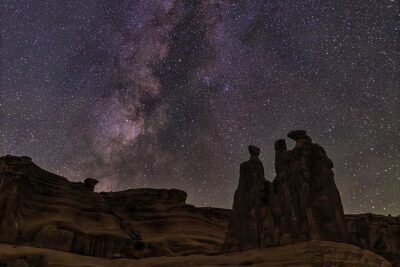
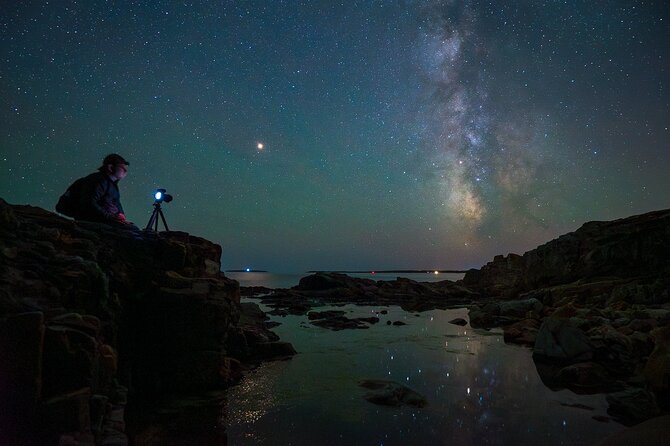
Acadia after dark gives you more than a starry sky. At Jordan Pond, Otter Cliff, Sand Beach, Bubble Pond, and Eagle Lake, the workshop pairs the Milky Way with rocks, water, cliffs, and moving clouds. Christopher, also called Chris, teaches you how to make those parts work together instead of simply pointing a camera upward.
I like the small maximum of five people, which gives Chris room to check settings and help with composition. I also like the mix of field shooting and editing, including a one-on-one post-processing session through Discord. The main drawback is the cost: $2,500 per person, before lodging, meals, and the park fee.
The workshop also asks a lot from you. You need a camera suited to long exposures, a fast wide-angle lens, a sturdy tripod, and basic manual-camera skills. Night work means late hours, repeated setup, and patience when weather does not cooperate.
Key points before you book
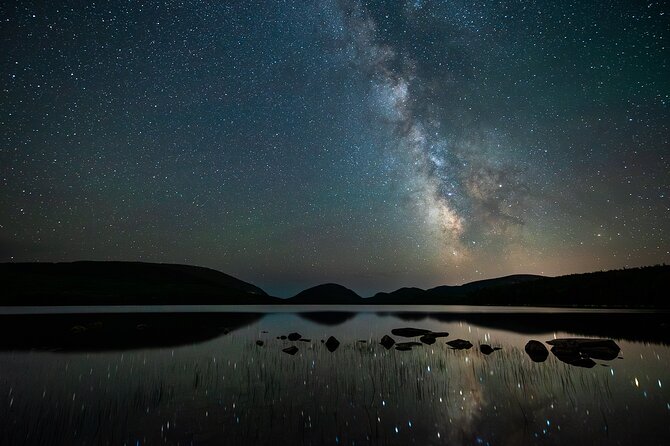
- Five Acadia locations: Work at Jordan Pond, Otter Cliff, Bubble Pond, Sand Beach, and Eagle Lake.
- Small-group teaching: The workshop accepts no more than five participants, with private transport inside the park.
- More than camera settings: Lessons cover PhotoPills planning, single exposures, stacked images, focus stacking, time-lapse work, and editing.
- Chris teaches the full process: Instruction runs from pre-shoot planning through Lightroom and Photoshop.
- Bring serious gear: You need a DSLR or mirrorless camera, a wide lens at f/2.8 or faster, a tripod, and an intervalometer unless your camera has one built in.
- Weather matters: The experience can be moved or refunded if poor conditions cancel the session.
Why Acadia works so well after dark
Acadia gives you strong foreground subjects close to the sky. That matters because a good night photograph is rarely just a field of stars. A cliff, pond, beach, or line of trees gives the image scale and a sense of place.
The workshop focuses on celestial storytelling, which is a useful way to think about the craft. You learn to place the Milky Way over a coastal feature, show star movement above a fixed foreground, or blend separate exposures so the sky and land both look their best.
Chris also teaches the practical problem behind many night images: the sky and foreground often need different exposures. One image may hold the Milky Way, while a longer exposure records detail in the rocks or trees. You can then blend the files in Photoshop.
That approach is more advanced than simply learning a shutter speed and aperture. It gives you a repeatable method for difficult scenes, especially when the foreground is much darker than the sky.
More National Park Stargazing in the USA
- Stargazing in Zion National Park’s International Dark Sky
★ 5.0 · 73 reviews - Astro-Photo, Hiking and Stargazing Tour in Arches National Park
★ 5.0 · 63 reviews - Stargazing and Milky Way Portrait in Capitol Reef National Park
★ 4.5 · 13 reviews
Five days of shooting and practice
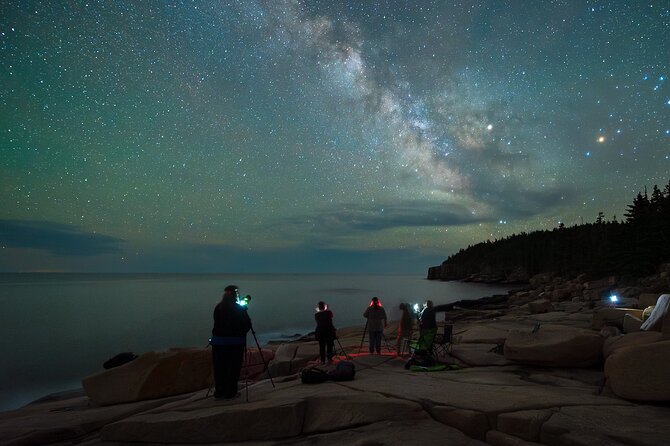
The experience lasts about five days, with field sessions scheduled during late-night and evening hours. The stated operating window is Tuesday through Saturday, from midnight to 3:30 a.m. and from 7 p.m. to 11:30 p.m.
Those hours fit the subject. You are not taking ordinary daytime snapshots with a few stars added later. You need darkness, and you need enough time to set up, focus, compose, shoot, check the result, and try again.
The schedule also means you should plan your stay in Bar Harbor around late nights and daytime rest. Lodging and meals are not included, so you arrange both yourself. Private transport within Acadia helps once you are ready to shoot, but it does not remove the need to manage your own accommodation and daily routine.
Jordan Pond: reflections and a strong starting point
Jordan Pond is the first listed stop. Its open water and surrounding mountain scenery give you a clean setting for combining sky and foreground.
This is a useful place to practice composition because the pond can provide reflection, while the dark shoreline gives the frame a lower anchor. You may work on keeping the Milky Way from floating without context, using the water and nearby forms to guide the eye.
Chris can also show you why a single exposure may not be enough. You might capture one file for the stars and another for the darker foreground, then work out how to blend them later.
A pond scene brings one possible challenge: reflections and water detail can change with conditions. That makes careful timing and framing important, rather than relying on one fixed camera position.
Otter Cliff: dramatic rock beside the stars
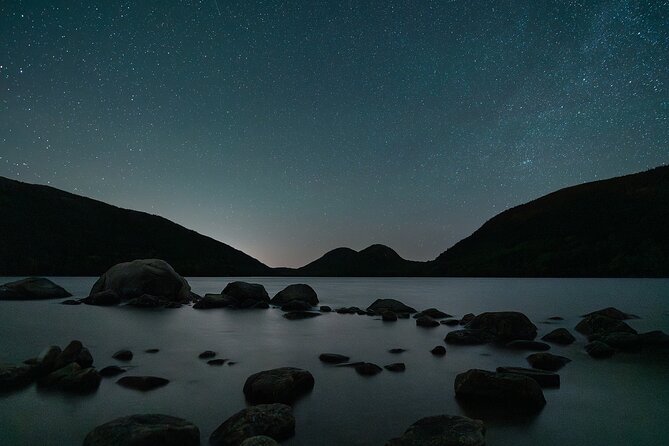
Otter Cliff brings a more forceful coastal subject. The rock formations give your images weight and direction, while the open sky provides room for the Milky Way or star trails.
This stop suits the workshop’s storytelling goal. Instead of making a generic sky image, you can show the relationship between the Atlantic coast and the night sky. The cliff becomes the reason the photograph could only have been made in Acadia.
Rocky viewpoints also make a sturdy tripod essential. A slight movement during a long exposure can soften stars and foreground details. You will want to take setup seriously here, especially if you are working with stacked frames or a focus-stacking sequence.
The setting can be visually dramatic, but it may also demand more care with composition. A large rock face can dominate the frame, so you will need to decide how much sky to include and where the main celestial feature should sit.
More Astrophotography Tours in the USA:
- Moab: The Windows Astro-Photography and Stargazing Hike
★ 4.8 · 36 reviews - Milky Way Photography in Arches National Park
★ 4.0 · 4 reviews - Private astronomy tour with sunset toast, picnic, and astrophotography
★ 4.8 · 83 reviews - AuthenticAs Star Gazing -Nightscape Portrait Photography Tour
★ 5.0 · 59 reviews
Bubble Pond: a quieter composition exercise
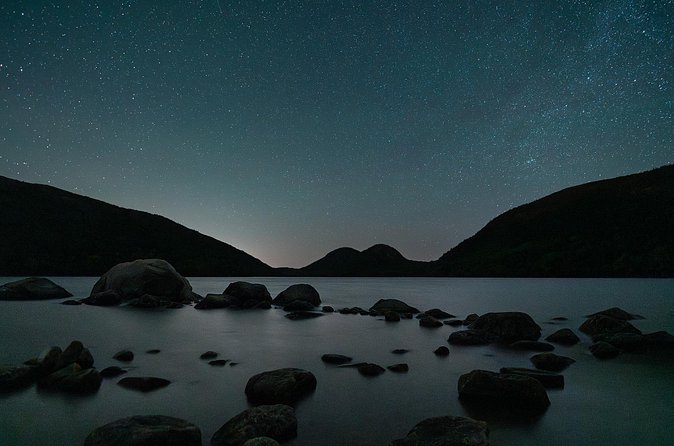
Bubble Pond offers another water-based setting, with a different feel from Jordan Pond. The stop gives you a chance to work with trees, water, and sky in a more layered composition.
This is where foreground planning becomes especially useful. A row of trees or a pond edge can create depth, while the sky supplies movement and scale. You will practice more than finding the brightest stars. You will decide what belongs in the image and what should be left out.
The workshop’s emphasis on focus stacking is valuable at scenes like this. A wide-angle lens at night may make it hard to keep both nearby foreground elements and distant stars sharp in one frame. Focus stacking lets you address that problem with several carefully made exposures.
Do not expect every frame to work immediately. Night photography rewards methodical setup. You may need to check focus, exposure, alignment, and the position of the Milky Way before committing to a series.
Sand Beach: open sky and a clear sense of place
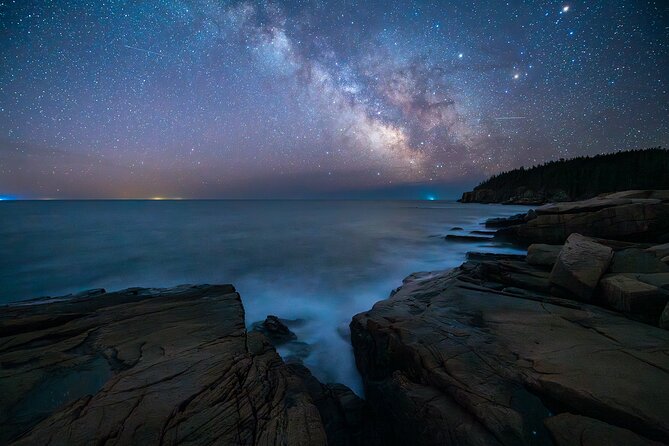
Sand Beach gives you a broad coastal setting and a simpler foreground than the rocky stops. The beach can help you make the sky the main subject while still showing where you are.
This is a good place to work on visual balance. A low shoreline can lead the eye toward the stars, while the curve of the beach or nearby rock can stop the frame from feeling empty.
The open setting may also expose mistakes more clearly. If the foreground is too dark, your composition lacks a clear anchor. If you brighten it too much, the image may lose the mood of night. The separate-exposure workflow taught in the workshop is designed for this kind of problem.
Sand Beach is also one of the locations where timing and weather may have a large effect on the final result. Clouds can add movement and atmosphere, but heavy cloud cover may block the stars entirely.
Eagle Lake: a final chance to build a complete image
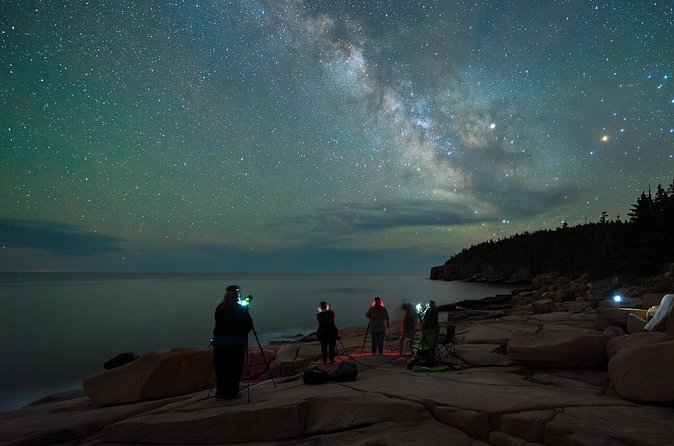
Eagle Lake rounds out the listed stops with another chance to work around water and nearby forms. By this stage, you should have more practice with camera setup, focus, stacking, and planning.
The value here is repetition. Astrophotography has many moving parts, and five days give you more than one chance to understand them. You can test a method at one location, then apply it differently at another.
Eagle Lake also fits the workshop’s focus on celestial movement. You may work with star trails, moving clouds, or time-lapse sequences rather than a single still frame. The supplied instruction includes time-lapse photography, and past workshop participants learned to combine images into time-lapse videos.
That broader approach makes this more than a Milky Way-only class. If you want to explore stars, clouds, motion, panoramas, and night scenery, the range of techniques adds value.
What Chris teaches in the field
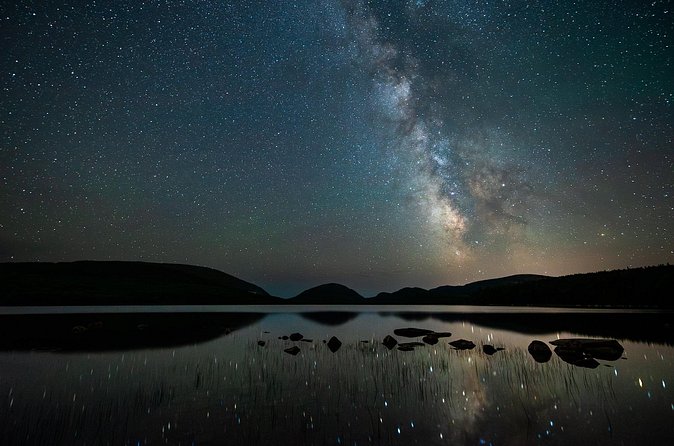
The field instruction begins with planning. You learn to use PhotoPills to predict the Milky Way’s position and work out how it will line up with a pond, cliff, beach, or other foreground element.
That planning can save you from arriving at a beautiful location with the sky in the wrong place. It also helps you make a deliberate image rather than hoping the Milky Way happens to fall where you want it.
You then work through practical shooting methods:
- Single-exposure night images
- Stacked exposures for cleaner detail
- Separate sky and foreground exposures
- Focus stacking
- Panoramas of the Milky Way
- Time-lapse images of stars and clouds
You need a basic grasp of manual settings before arriving. This is not designed as a first lesson in how to operate a camera. The workshop is better suited to someone who can already change aperture, shutter speed, ISO, and focus, but wants a stronger night workflow.
Chris’s teaching style, based on the information provided, emphasizes patience and hands-on guidance. That matters in a small group. You are not left with only a lecture and a list of settings. You work at actual Acadia locations and can ask about the image in front of you.
Editing is a major part of the value
The post-processing work may be the most useful part for many photographers. Capturing the files is only half the job. You also need to sort, blend, sharpen, color-correct, and prepare them for a finished image.
Instruction covers Lightroom and Photoshop. You will work with workflows for stacked images, separate exposures, focus stacking, panoramas, and time-lapse material.
The one-on-one Discord session is an important inclusion. It gives you dedicated time to address your own files rather than only following a general demonstration. You can use that session to ask how to improve a particular image, manage a difficult blend, or organize the editing process.
The workshop also includes support after the main field instruction, according to the provided details. That can matter when you return home and discover that the editing lesson raises new questions.
The $2,500 price: who gets good value
At $2,500 per person, this is a serious purchase. You are paying for a five-day specialist workshop, private transport inside Acadia, expert instruction, water and snacks in the vehicle, and the individual online editing session.
The maximum group size of five improves the value. A large class would make it harder for Chris to check your tripod position, camera settings, focus, or composition. With only a few people, personal attention is more realistic.
The price makes less sense if you only want a guided visit to Acadia at night. You could see the locations for far less by arranging your own transport and photography time. You are paying for instruction and a structured process, not just access to scenic viewpoints.
You also need to add lodging, meals, camera equipment, and the park admission cost. The supplied details list a $20 per-person fee and refer to a valid Yellowstone National Park pass, which does not match Acadia National Park. Confirm the correct park fee and pass requirement with Wildscape Adventure before booking.
Gear and fitness requirements
The equipment list is specific:
- DSLR or mirrorless camera capable of long exposures
- Wide-angle lens with an aperture of f/2.8 or faster
- Sturdy tripod
- External intervalometer, unless your camera includes one
- Basic knowledge of manual camera settings
- Basic post-processing ability
The fast lens matters because night scenes require as much light as possible. The tripod matters because even a small shake can ruin a long exposure or make stacked frames misalign.
You should also expect a moderate level of physical fitness. The information does not give trail distances or elevation details, so you should ask Wildscape Adventure about the walking required at each stop if that affects your decision.
Service animals are allowed. Pickup is offered, and the workshop is conducted in English.
Weather, timing, and cancellation
Clear skies are never guaranteed in a night-sky workshop. Clouds can block the Milky Way, and poor conditions can make long exposures frustrating or impossible.
If the experience is canceled because of weather, you receive the option of another date or a full refund. The same applies if the minimum number of participants is not reached.
You can cancel for a full refund if you do so at least 24 hours before the start time. Cancellations or changes made inside that window are not accepted for a refund.
Those terms are reasonable for an activity that depends on weather, but the late-night schedule makes planning important. Keep some flexibility in your Bar Harbor stay if the sky forecast looks uncertain.
Who should book this workshop?
I would recommend it most to photographers who already understand basic manual shooting and want to produce stronger night images. You should be comfortable carrying and setting up your own equipment, working late, and spending time on editing.
It is also a good fit if you want more than Milky Way snapshots. The instruction includes star trails, time-lapse work, panoramas, focus stacking, and blended exposures, so the skills can carry into other night and scenic photography.
I would be more cautious if you are new to cameras, dislike post-processing, or mainly want a relaxed sightseeing trip. The five-day format and technical focus ask for commitment.
Should you book the Acadia Milky Way workshop?
Book it if you want close instruction from Chris, a small group, repeated practice at major Acadia locations, and a full path from PhotoPills planning to Photoshop editing. The private vehicle and one-on-one Discord session add practical value, especially at this price.
Skip it if you only need a guide to scenic viewpoints or do not yet own the required gear. Before paying, confirm the park fee wording, pickup details, lodging arrangements, and the exact schedule for your dates. For an aspiring night photographer ready to work hard, this offers a focused way to turn Acadia’s dark skies and coast into finished images.
FAQ
How long is the Milky Way photography workshop?
The workshop lasts approximately five days.
Where does the workshop take place?
The workshop is based in Bar Harbor and takes place within Acadia National Park.
Which locations are included?
The listed stops are Jordan Pond, Otter Cliff, Bubble Pond, Sand Beach, and Eagle Lake.
What is included in the price?
The price includes private transportation within Acadia National Park, expert instruction, bottled water and snacks in the transport vehicle, and a one-on-one post-processing session through Discord.
Are meals and lodging included?
No. You arrange and pay for meals and lodging separately.
What camera equipment do I need?
You need a DSLR or mirrorless camera capable of long exposures, a wide-angle lens at f/2.8 or faster, a sturdy tripod, and an external intervalometer unless your camera has one built in.
What happens if the weather is poor?
If poor weather causes the experience to be canceled, you can choose another date or receive a full refund.
Can I cancel the workshop?
You can cancel for a full refund at least 24 hours before the experience start time. Cancellations or changes made less than 24 hours in advance are not accepted for a refund.
More Milky Way Tours in the USA
- The Night Sky Star Story, Galaxy, and Sedona Story Tour
★ 4.5 · 243 reviews - Mount Bromo Milky Way Photography and Sunrise Private Tour (1D1N)
★ 5.0 · 6 reviews
Just in after dark around the USA
- Seattle: Hop-on Hop-off Bus Tour and Sky View Observatory★ 4.4 · 16 reviews
- Boulder: Guided Astronomy Tour★ 4.7 · 11 reviews
- 1-Day Grand Canyon Tour from Las Vegas: Stargazing & Sunrise★ 3.6 · 3 reviews
- Griffith Observatory: Scott E-Bike Tours LA Private Tour★ 5.0 · 32 reviews
- Private Tour of Griffith Observatory★ 4.5 · 58 reviews
- Milky Way Photography in Arches National Park★ 4.0 · 4 reviews
- Professional Stargazing in Moab★ 3.5 · 3 reviews
- Astro-Photo, Hiking and Stargazing Tour in Arches National Park★ 5.0 · 63 reviews
Astrophotography Tours, night against night.
Private astronomy tour with sunset toast, picnic, and astrophotography
Read our review →
AuthenticAs Star Gazing -Nightscape Portrait Photography Tour
Read our review →
The Windows Astro-Photography and Stargazing Hike
Read our review →
Doha Night Desert Safari, Stargazing, Photography، Relaxation
Read our review →
Stargazing and Milky Way Portrait in Capitol Reef National Park
Read our review →
Mount Bromo Milky Way Photography and Sunrise Private Tour (1D1N)
Read our review →