Review · MOAB
Milky Way Photography in Arches National Park
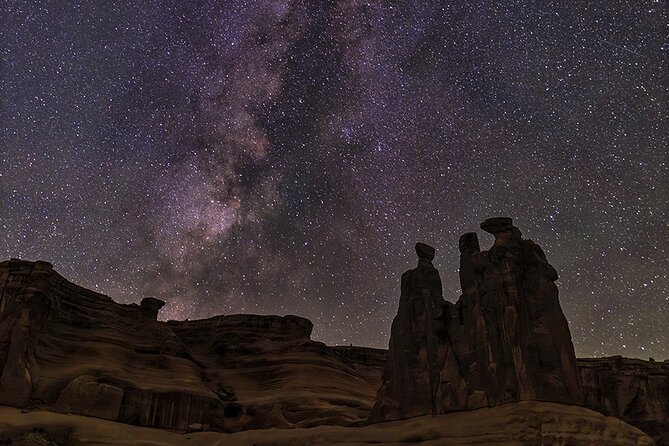
Seeing the Milky Way over Arches National Park is the main event here, but the real value is learning how to photograph it yourself. Colin Young and Geremy help you set up your camera, explain composition, and make the strange business of night photography feel manageable. I especially like the maximum group size of four and the chance to work at at least two locations.
The tour includes water, snacks, and camera instruction, which keeps the evening simple and practical. The main catch is timing: from March through May, the Milky Way appears only after midnight, and fall departures are offered only as a sunset and night combination. You’ll also need suitable gear and enough comfort with darkness for a late outing.
Key points to know before booking
- Small group instruction: The maximum is four people, so you get more personal help than on a large coach tour.
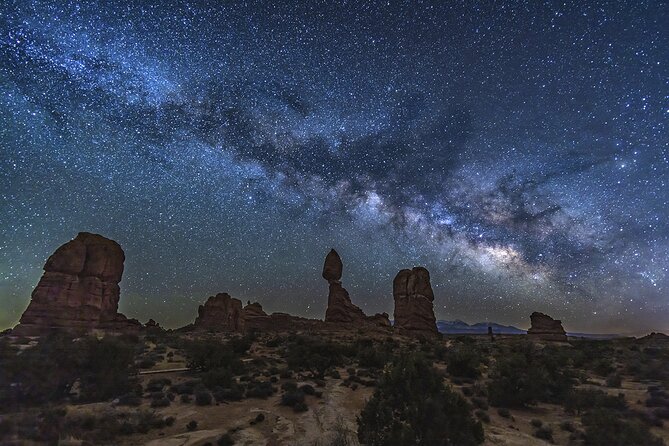
- Two Arches locations: You will photograph the Milky Way in at least two spots inside the national park.
- Bring the right camera: A DSLR or mirrorless camera that can shoot at ISO 3200 or higher is strongly recommended.
- Timing changes by season: March through May requires a late-night, after-midnight start, while fall is offered as a sunset and night combination.
- Colin and Geremy teach, not just drive: Expect help with settings, framing, and night photography technique.
- Practical extras are included: Water, trail mix or snack bars, and gluten-free snack options are provided.
Why Arches after dark is worth your time
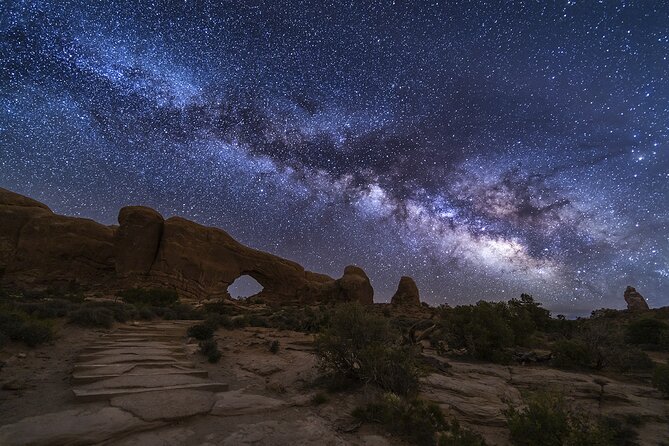
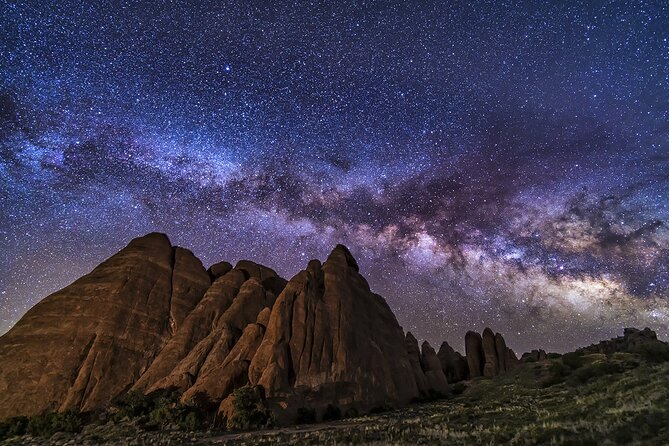
Arches National Park is famous for its red rock by day, but darkness changes the whole experience. Under a clear sky, the Milky Way becomes the subject rather than a faint background detail. Arches provides dramatic foreground shapes, open sky, and natural framing that can make a night photograph far more interesting than a simple star field.
You are not just pointing a camera upward. The goal is to balance the stars with the park’s stone formations. That takes some planning, and this is where guided help matters. Colin’s instruction focuses on the settings that beginners often struggle with: high ISO, a wide aperture, focus in the dark, and long exposures.
The setting is also an internationally recognized dark-sky park. That does not guarantee perfect conditions on every night, since clouds and moonlight still matter, but it gives the outing a strong foundation. If you live near a large city, the number of visible stars can be a surprise.
More National Park Stargazing in the USA
- Stargazing in Zion National Park’s International Dark Sky
★ 5.0 · 73 reviews - Astro-Photo, Hiking and Stargazing Tour in Arches National Park
★ 5.0 · 63 reviews - Stargazing and Milky Way Portrait in Capitol Reef National Park
★ 4.5 · 13 reviews
A short lesson before the first photograph
The evening begins with a crash course in Milky Way photography. You will learn how to prepare your DSLR or mirrorless camera for low-light work, rather than spending the entire outing guessing at buttons and menus.
This early help can save a lot of frustration. Night photography is not very forgiving when you are unfamiliar with your camera. A setting that works for a daytime portrait may produce a nearly black frame at night, while autofocus often becomes unreliable when there is little light.
Colin has also sent camera instructions ahead of time for some bookings. If you receive that information, read it before meeting the group and make a few practice adjustments at home. You do not need to become an expert before arrival, but knowing where your ISO, aperture, manual focus, and shutter controls are located will give you more time under the stars.
The instruction is best suited to people who want to understand their equipment. You do not have to be an experienced photographer, and one especially useful feature is that Colin and Geremy can help with different camera systems. Still, this is not a standard sightseeing trip where you simply watch someone else take pictures.
At least two nighttime locations inside Arches
The only listed stop is Arches National Park, but the experience includes photography at at least two locations within the park. That matters because each site can offer a different balance of open sky, rock formations, and possible compositions.
You will likely spend time getting set up at each place, checking the framing, and making several exposures. Night photography rewards patience. A tripod must remain still, people need to avoid bumping it, and small changes in composition can make a big difference.
The move to a second location also gives the evening some variety. If one composition does not work for your lens or camera position, the next site may offer a better arrangement of rock and sky. The guide’s familiarity with the park helps here, especially when you are trying to decide how much foreground to include.
Do not expect a rapid-fire sightseeing schedule. The three-and-a-half-hour duration includes travel, instruction, setup, and shooting. You will get more from the tour if you are happy to spend time in one place refining a photograph instead of racing to collect snapshots.
What the guides add to the evening
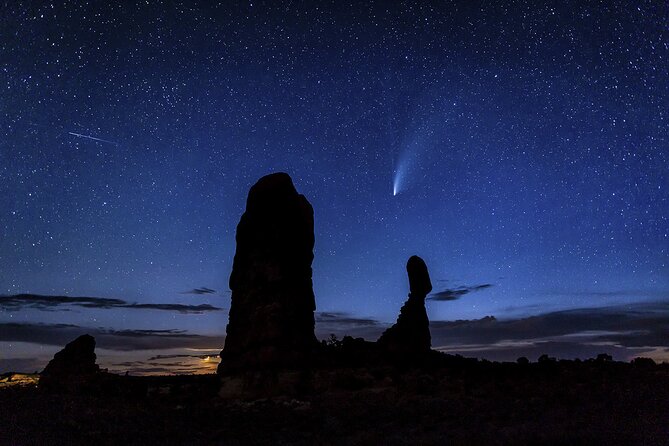
Colin Young leads the experience, and Geremy may also assist. Their role goes beyond basic camera settings. They can help you decide where to place the horizon, how to use a natural arch or rock wall in the frame, and how to make the Milky Way part of a larger picture.
That composition advice is one of the strongest reasons to choose a guide instead of heading into the park alone. Camera settings can be found in a manual. Finding a pleasing arrangement of sky and stone is harder when you are working in darkness and unfamiliar surroundings.
The teaching style described for this experience is patient and open to questions. That should appeal to beginners who might feel embarrassed about not knowing their camera. It also suits photographers who already understand manual settings but want better ideas for working with Arches scenery at night.
The small group limit helps. With no more than four people, you have a better chance of getting direct attention when your image is too dark, your focus is soft, or your composition needs a small adjustment. A bigger group would make that kind of hands-on teaching harder.
More Astrophotography Tours in the USA:
- Moab: The Windows Astro-Photography and Stargazing Hike
★ 4.8 · 36 reviews - Milky Way Photography Workshop in Acadia National Park
★ 5.0 · 8 reviews - Private astronomy tour with sunset toast, picnic, and astrophotography
★ 4.8 · 83 reviews - AuthenticAs Star Gazing -Nightscape Portrait Photography Tour
★ 5.0 · 59 reviews
Gear you should bring
This tour depends heavily on what you bring. You should have a DSLR or mirrorless camera capable of shooting at least ISO 3200. A late-model iPhone or another advanced phone camera may work, but the experience is built around interchangeable-lens cameras.
A wide-angle lens gives you the best chance of including both the Milky Way and the red rock foreground. The recommended range is 14mm to 35mm on a full-frame camera, or about 10mm to 24mm on a crop-sensor camera. The lens should open to at least f/3.5, with a wider aperture being better for gathering light.
You also need a sturdy tripod. This is not optional if you want sharp long exposures. The provider may be able to lend a spare tripod, but that is not guaranteed, so ask before relying on it.
Bring a headlamp or flashlight, preferably one with a red-light setting. Red light is useful at night because it is less disruptive than a bright white beam. You will need some form of light to handle your equipment and move carefully, but you should use it thoughtfully around people who are composing images.
The camera is not supplied. If you are hoping to use only a basic phone, treat that as a possibility rather than a promise. Advanced phones may capture the Milky Way, but the instruction is designed primarily for DSLR and mirrorless users.
Seasonal timing can shape the whole experience
The date you choose matters more than it does on many short tours. From March through May, the Milky Way does not appear until after midnight. During that period, the night photography trip is offered as a standalone late-night tour, with a pickup in the early hours.
That schedule may be perfect if you are determined to photograph the galaxy, but it can be rough after a full day in the desert. Plan your daytime activities with the late start in mind. You may enjoy the tour less if you have already spent the day on strenuous walks and then try to stay alert into the morning.
In fall, the provider offers only a sunset and night combination. This changes the rhythm of the experience. You get the chance to see the park before darkness and then continue into night photography, but you should confirm the exact seasonal departure details when booking.
The supplied information does not promise a particular moon phase, weather condition, or exact arch at each stop. That is worth keeping in mind. The tour teaches you how to work with the night sky, but no guide can guarantee a perfect Milky Way photograph every time.
Price and value at $275 per person
At $275 per person, this is a premium small-group outing. The price makes the most sense if you place real value on instruction and personal help rather than simply wanting transportation into Arches after dark.
You are paying for about three and a half hours, a maximum group of four, access to at least two photography locations, camera instruction, and the guide’s experience with the park. Water and snacks are useful but are not what justify the cost. The main value is the time spent improving your own photographs.
For a first night photography experience, that can be worthwhile. A poorly prepared solo attempt may leave you with blurry or black images and little idea what went wrong. A guide can shorten that learning curve and help you leave with a better understanding of your camera, even if the final photographs are not perfect.
The value is weaker if you already shoot night skies confidently and only want a ride to a viewpoint. In that case, you may be paying mostly for access and company rather than instruction. The tour is best for people who want to learn, need help with composition, or prefer not to work alone in a dark national park.
Group discounts are offered, which may improve the cost for people booking together. Since availability can be limited and the experience is often reserved well ahead of time, plan early if the dates of your Arches visit are fixed.
Pickup, meeting point, and the late return
The listed meeting point is the Moab Information Center at 25 East Center Street in Moab. The activity ends back at that meeting point. Pickup is offered, but you should confirm the pickup arrangement rather than assume it replaces the stated meeting point.
The outing lasts approximately three hours and 30 minutes. That is long enough for instruction and two shooting locations without turning into an all-night workshop under normal scheduling, though the March through May version begins late because of the Milky Way’s seasonal appearance.
Bring water containers if you have them. The guide provides a cooler of ice water for refills, along with snack bars or trail mix, including gluten-free options. These are small touches, but they matter during a late outing when nearby food options may not be available.
The activity requires a moderate level of physical fitness. The information does not specify the distance or difficulty of each walk, so ask if you have concerns about nighttime footing. It is also not recommended for people with poor night vision. Darkness is part of the experience, not a minor detail.
Who should book this night photography tour
I would choose this experience if you meet most of these conditions:
- You own a DSLR or mirrorless camera and want practical help using it at night.
- You have, or can arrange, a wide-angle lens and sturdy tripod.
- You enjoy a small group and direct instruction.
- You are comfortable with a late-night or after-midnight schedule.
- You want photographs that include Arches rock formations, not just stars.
- You are willing to spend time setting up and repeating exposures.
It can also work for a mixed group. People without cameras, or those carrying only cell phones, can still enjoy the dark sky and scenery while others photograph. However, the strongest value goes to the person who brings suitable equipment and wants to improve.
I would think twice if you dislike standing outside at night, have poor night vision, or expect a relaxed sightseeing ride with little technical content. The experience asks you to pay attention, handle your equipment, and remain patient while exposures are made.
Booking, cancellation, and a small caution
Confirmation is sent within 48 hours of booking, subject to availability. The experience may be booked well in advance, with an average lead time of about 57 days, so last-minute plans may have fewer choices.
You can cancel up to 24 hours before the experience for a full refund. One practical caution is that this is a one-person operation, and availability errors have occurred. If your schedule depends on this outing, confirm the date promptly and keep any alternate guide or date information handy.
That issue does not erase the value of the instruction, but it does mean you should not build an entire complicated itinerary around this one booking without checking that the date is firmly confirmed.
Should you book Milky Way Photography in Arches?
Book it if you want more than a pretty night view. The small group, two-location format, and hands-on guidance from Colin Young and Geremy give you a real chance to improve your camera work while photographing one of the best-known dark skies in the American Southwest.
The clearest reason to skip it is equipment or timing. You need the right camera setup, a tripod, and patience for darkness. March through May also means an after-midnight start, while fall follows a sunset and night format.
For a beginner with a serious interest in night photography, $275 can be fair value. For someone who only wants a quick look at the stars, it is probably more instruction than you need. Bring the right gear, protect your sleep schedule, and confirm the seasonal timing. Do that, and this can turn a difficult kind of photography into a rewarding part of your Moab visit.
FAQ
Where does the tour begin?
It begins at the Moab Information Center, 25 E Center St, Moab, Utah 84532.
Where does the activity end?
The activity ends back at the meeting point in Moab.
How long does the experience last?
It lasts approximately three hours and 30 minutes.
How many people can join the tour?
The maximum group size is four people.
What camera should I bring?
Bring a DSLR or mirrorless camera capable of shooting at least ISO 3200. Late-model iPhones and other advanced phone cameras may also be able to capture the Milky Way.
What lens is recommended?
A wide-angle lens is best. The recommended range is about 14mm to 35mm on a full-frame camera, or 10mm to 24mm on a crop-sensor camera, with an aperture of f/3.5 or wider.
Do I need a tripod?
You should bring a sturdy tripod. The provider may be able to loan a spare tripod, but that is not guaranteed.
Does the tour include food and water?
Yes. Snack bars or trail mix are provided, including gluten-free options, along with ice water for refilling reusable bottles.
Does the tour run at the same time all year?
No. From March through May, the Milky Way appears after midnight, so the standalone tour begins with a late-night pickup. In fall, only a sunset and night combination is offered.
Can I cancel for a refund?
Yes. You can cancel up to 24 hours before the experience for a full refund.
More Milky Way Tours in the USA
- The Night Sky Star Story, Galaxy, and Sedona Story Tour
★ 4.5 · 243 reviews - Mount Bromo Milky Way Photography and Sunrise Private Tour (1D1N)
★ 5.0 · 6 reviews
Just in after dark around the USA
- Seattle: Hop-on Hop-off Bus Tour and Sky View Observatory★ 4.4 · 16 reviews
- Boulder: Guided Astronomy Tour★ 4.7 · 11 reviews
- 1-Day Grand Canyon Tour from Las Vegas: Stargazing & Sunrise★ 3.6 · 3 reviews
- Griffith Observatory: Scott E-Bike Tours LA Private Tour★ 5.0 · 32 reviews
- Private Tour of Griffith Observatory★ 4.5 · 58 reviews
- Stargazing and Milky Way Portrait in Capitol Reef National Park★ 4.5 · 13 reviews
- Haleakala Sunset and Stargazing Audio Tour★ 4.0 · 10 reviews
- Stargazing Tour in Kapalua★ 5.0 · 31 reviews
Astrophotography Tours, night against night.
Private astronomy tour with sunset toast, picnic, and astrophotography
Read our review →
AuthenticAs Star Gazing -Nightscape Portrait Photography Tour
Read our review →
The Windows Astro-Photography and Stargazing Hike
Read our review →
Doha Night Desert Safari, Stargazing, Photography، Relaxation
Read our review →
Stargazing and Milky Way Portrait in Capitol Reef National Park
Read our review →
Milky Way Photography Workshop in Acadia National Park
Read our review →