
Review · MOAB
Astro-Photo, Hiking and Stargazing Tour in Arches National Park
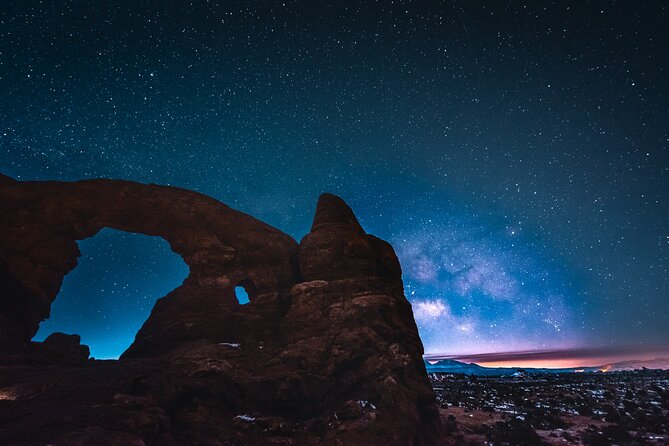
Arches National Park takes on a different character after sunset. The red rock fades into silhouette, the crowds disappear, and the Milky Way turns the arches into natural frames for the night sky. This two-hour outing combines a short nighttime hike with practical astrophotography help, so you are not just looking up, you are learning how to capture what you see.
I like the small maximum group of six, which gives you a fair chance to get personal help with camera settings. I also like the provided headlamps and tripods, especially if you are new to night photography. The main drawback is the meeting point: you need to drive yourself to the Windows Section Parking Lot, and dark roads inside the park can be difficult if you have never visited Arches before.
Key points to know before booking
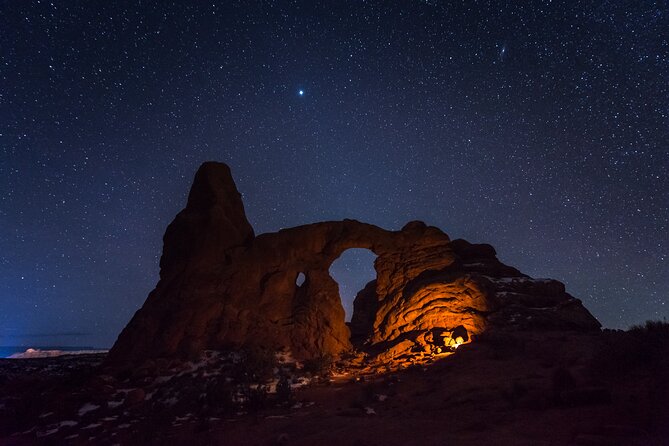
- The Milky Way becomes part of the scenery: Arches and constellations share the same frame, creating photos you cannot get during daylight.
- Tripods and headlamps are provided: You do not need to bring all the basic night-photography gear yourself.
- Phone photographers are welcome: Guides have helped visitors improve images with ordinary smartphones, not just SLR cameras.
- The group is limited to six people: That matters when you need help with focus, exposure, or framing.
- There is no telescope listed: This is an astrophotography and stargazing walk, not a telescope viewing session.
- You return to the starting point: The tour begins and ends at the Windows Section Parking Lot.
Arches after dark, when the park goes quiet
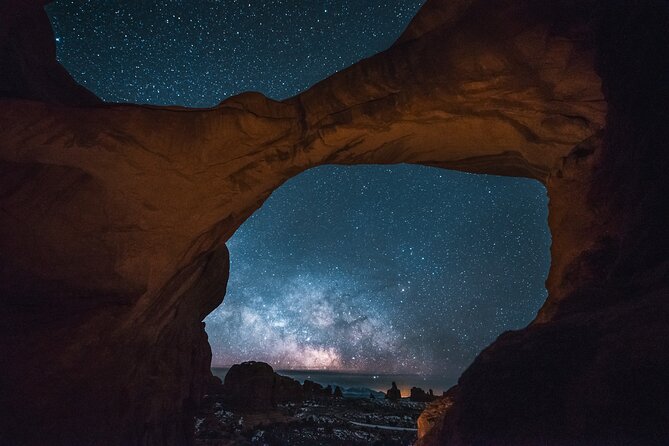
The Windows Section is a fitting place for this kind of outing. Arches National Park is famous for its stone openings, but at night the formations become more than daytime photo stops. You see them as dark shapes against a field of stars, with the curved rock acting like a frame around the constellations.
The tour description focuses on moving through this rock garden and considering how wind, water, and time shaped the arches. At night, the geology becomes harder to inspect in detail, but the sky takes over. You get a strong sense of scale as the stars appear to rotate above the formations.
That change in mood is one of the best reasons to book a night tour instead of simply returning to the park during daylight. The evening temperatures are cooler, and the usual daytime crowds are gone. You can pay attention to the sky, the rock, and your camera rather than trying to work around busy viewpoints.
The outing lasts about two hours. That is long enough to make several photographs and learn the basics without turning into a late-night expedition. It is also short enough to fit into a Moab itinerary that already includes a full day of hiking or sightseeing.
More National Park Stargazing in the USA
- Stargazing in Zion National Park’s International Dark Sky
★ 5.0 · 73 reviews - Stargazing and Milky Way Portrait in Capitol Reef National Park
★ 4.5 · 13 reviews - Milky Way Photography Workshop in Acadia National Park
★ 5.0 · 8 reviews
What happens at the Windows Section Parking Lot
You meet at the Windows Section Parking Lot in Arches National Park, Utah. The activity ends at the same place, so you do not need to arrange a second pickup point.
The meeting location is close to trails, which keeps the evening focused. You are not spending much of the two hours waiting for a transfer or moving between distant parts of the park. Instead, you begin near the formations that provide the main photo subjects.
You should plan your route carefully before leaving Moab. Transportation to the meeting point is not included in the details provided, and one visitor found the dark roads to the site challenging, especially on a first visit to Arches. Give yourself time to find the parking lot and get settled before the start time.
This is an important practical point. A night drive through an unfamiliar national park is a different task from reaching a daytime viewpoint. You will want your directions ready, your fuel sorted, and your phone charged before setting out. The tour itself ends where it starts, but getting there and back is your responsibility.
Learning night photography without a professional camera
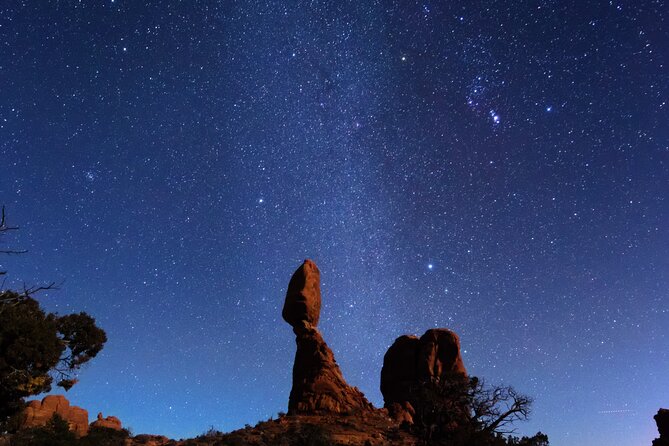
The strongest feature here is the hands-on photography help. You receive a tripod and headlamp, then work with your guide on the practical problems that make night images tricky: keeping the camera steady, finding focus in darkness, and setting the phone or camera to collect enough light.
Guides named Sam and Brandon have been praised for explaining both the stars and the equipment in clear terms. Brandon has helped people with no night-photography experience produce Milky Way images they were proud of. Sam has also been noted for helping with camera settings, phone settings, arches, and the stars.
You do not need to arrive with an SLR camera. The guides can show you how to get more from a smartphone, which makes this activity useful for a wider range of visitors. If you are carrying a newer phone with a night or long-exposure mode, you may learn how to use it more effectively in a very dark setting.
A tripod matters even more than an expensive camera in this situation. The camera needs to remain still during a long exposure, and a hand-held image will usually blur. Since a tripod is provided, you can try this kind of photography without buying or packing one for the rest of your trip.
The guide may also help you frame people or personal items with the sky. One family used a small stuffed yellow-bellied marmot as part of a star photo, showing how the activity can be playful as well as technical. You are not limited to empty sky images. You can include your family, a travel keepsake, or the arch itself.
Stargazing, constellations, and the Milky Way
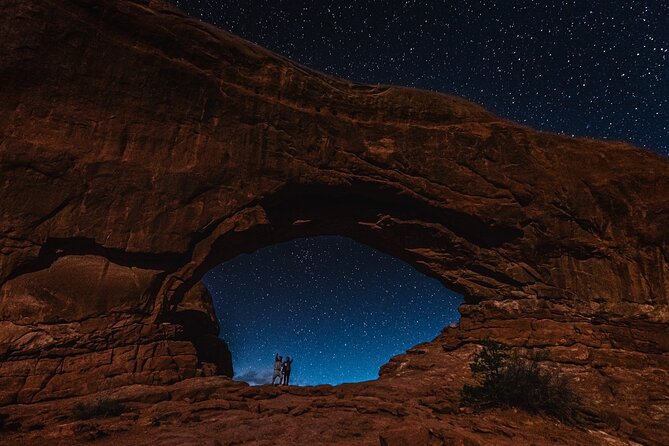
This is not simply a camera lesson. The guide also points out constellations and explains what you are seeing above the arches. The setting far from city lights gives the sky a major role in the experience.
The phrase galaxy looming large is not just decoration here. In a dark place, the Milky Way can appear as a distinct band rather than a faint smudge washed out by urban light. Exact visibility depends on weather and sky conditions, but the tour is designed around that possibility.
You should expect explanation rather than a formal astronomy lecture. The focus is on connecting the stars to the rock formations and helping you recognize some of the night sky. That balance works well for families and first-time stargazers, especially because the guide can adjust the discussion while helping with photos.
Children can take part, too. The experience has worked well for families with teenagers, and the guide can keep the outing engaging while explaining constellations. Still, you should be comfortable with a nighttime outdoor setting and a short walk near uneven natural terrain. The supplied information says most people can participate, but it does not provide a detailed accessibility description.
Same stars, another vantage point:
- Small Group Big Island Twilight Volcano and Stargazing Tour
★ 5.0 · 1,619 reviews - Griffith Observatory Hike: Guided Tour through Griffith Park
★ 5.0 · 1,020 reviews - Sedona Stargazing Tours LLC
★ 4.5 · 881 reviews - Los Angeles: Hollywood Night Tour with Griffith Observatory
★ 4.2 · 531 reviews
Why a group of six changes the experience
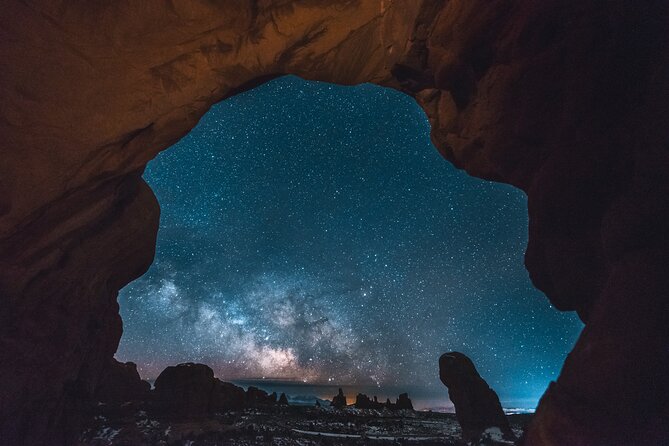
A maximum of six people is a real advantage for this kind of tour. Night photography often involves individual problems. One person needs help with a phone setting, another cannot find focus, and someone else wants to change the composition. In a large group, those questions can take a long time to reach.
With six or fewer, you have a better chance of receiving direct help. You can ask the guide to check your settings, suggest a position for the arch, or explain why your image is too dark. That personal attention is a major part of what you are paying for.
Group discounts are available, though the specific discount amount is not provided. If you are booking for several people, check the price before confirming. The small group also makes this a good choice for a family or a few friends who want one shared activity rather than separate instruction.
The tradeoff is that the experience is not private unless you arrange it that way. Other people may be in the group, and the guide must divide time among everyone. With a six-person limit, that compromise is fairly modest.
Is $175 a fair price for two hours?
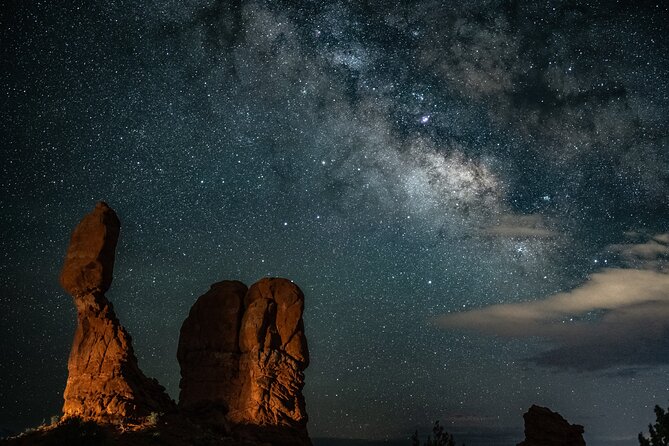
At $175 per person, this is not a cheap add-on to a Moab vacation. The tour lasts about two hours, and admission to Arches National Park is listed as free for the activity itself. You also need to provide your own transportation to the Windows Section Parking Lot.
The value comes from the combination of location, timing, equipment, and instruction. You are paying to reach a dark-sky setting with a guide who can help turn a difficult subject into usable photos. The tripod and headlamp save you from bringing or renting those items, while the small group gives you a better shot at one-on-one assistance.
I would consider the price fair if you care about leaving with new photography skills or memorable Milky Way images. It is less convincing if you only want a quick look at the stars. You can enjoy the night sky without specialized instruction, and the tour does not list a telescope.
That missing telescope is worth noting. If you picture an evening spent viewing planets and distant objects through a large scope, this is not that experience. The emphasis is on the naked-eye sky, constellations, Arches formations, and photography with your phone or camera.
What to bring and how to prepare
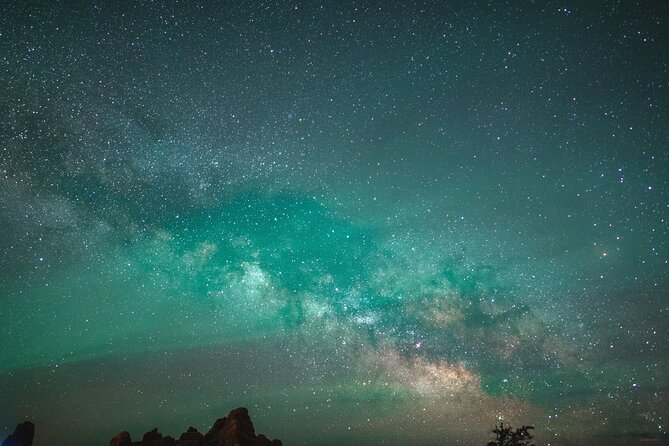
The equipment supplied is useful, but you still need to prepare for an outdoor evening. Wear clothing suitable for cooler temperatures and shoes you can use on a short trail. The available information does not specify the exact route or distance, so avoid assuming this is a paved viewpoint stop.
Bring the camera or phone you want to use. If you have an SLR or another adjustable camera, bring it with a charged battery and enough storage. If you only have a phone, that is fine, since the guides have helped people improve phone images.
A few simple preparations will make the two hours more productive:
- Charge your phone and camera fully.
- Clear storage space for several test images.
- Bring any camera manual or know how to open manual or night settings.
- Have directions to the Windows Section Parking Lot ready before dark.
- Allow extra driving time, since the roads may be unfamiliar at night.
The supplied headlamps are useful for safety and for finding your way, but you should still pay attention to where you walk. Bright white light can also affect other people’s night vision, so follow the guide’s instructions about when to use it.
Weather can change the whole evening
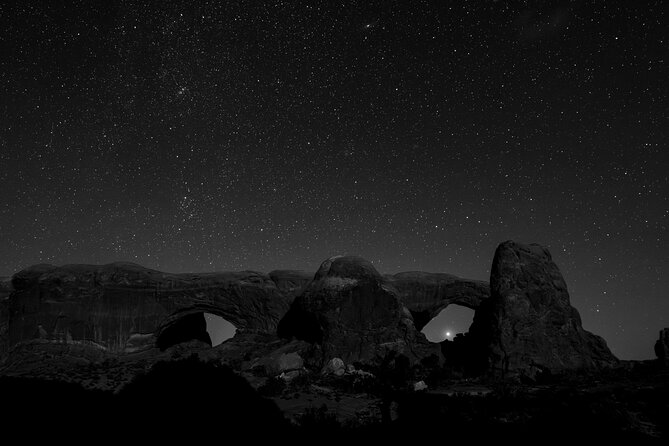
Good weather is required for this experience. Clouds, storms, or other poor conditions can make both stargazing and astrophotography disappointing, so the operator may cancel and offer another date or a full refund.
This condition is sensible, but it affects your planning. If the tour is important to you, avoid placing it on the final night of a short Moab visit. A later date is only useful if you are still in town.
You may cancel for a full refund if you do so at least 24 hours before the start time. Cancellations or changes made less than 24 hours in advance are not refunded or accepted. The cut-off follows local time.
Who will enjoy this Arches night tour
I would recommend it most strongly to you if you fit one of these descriptions:
- You want to photograph the Milky Way but do not know where to start.
- You have a phone and want better night images without buying a camera.
- You enjoy national parks after the crowds leave.
- You are visiting Moab with family members or a small group.
- You want a guide to connect astronomy with the rock formations.
- You value instruction and equipment more than a low-cost stargazing stop.
It is also a good choice for a first attempt at astrophotography. The guide can help you avoid the usual frustrations, such as a soft image, an empty black frame, or a photo that shows stars but loses the arch.
I would hesitate if your main goal is a telescope session, a long hike, or a private vehicle tour. None of those are listed as part of the experience. I would also think twice if reaching the Windows Section after dark would make you uncomfortable, since you must arrange your own transport.
Should you book it?
Book this tour if you want more than a look at the stars. The best reason to go is the mix of Arches scenery, dark skies, and patient camera help. You can arrive with little photography experience, use the provided tripod and headlamp, and leave with a better understanding of how to photograph the Milky Way.
At $175, it is a special-interest outing rather than a bargain activity. The price makes the most sense for people who will use the instruction, appreciate the six-person limit, and want photos to remember the evening. If that sounds like you, this is a strong way to see Arches from a quieter and more unusual angle.
FAQ
Where does the tour begin?
It begins at the Windows Section Parking Lot in Arches National Park, Utah.
Where does the tour end?
The activity ends back at the Windows Section Parking Lot.
How long does the experience last?
The tour lasts approximately two hours.
How much does the tour cost?
The listed price is $175 per person. Group discounts are available.
How many people can join?
The tour has a maximum of six participants.
Is photography equipment provided?
Yes. Headlamps and tripods are provided. Guides also help with camera and phone settings.
Do I need an SLR camera?
No. The guides can help you improve photographs with a phone, and an SLR camera is not required.
Is a telescope included?
No telescope is listed. The activity focuses on stargazing, constellations, the Milky Way, and astrophotography.
Can I cancel for a refund?
Yes. You can receive a full refund if you cancel at least 24 hours before the start time. If poor weather cancels the activity, you will be offered another date or a full refund.
More Night Hikes in the USA
- Los Angeles: Griffith Observatory Guided Hike/Walking Tour
★ 4.9 · 199 reviews - Hollywood Sign Hiking Tour to Griffith Observatory
★ 4.9 · 106 reviews - Hollywood Sign Hiking Tour to Griffith Observatory
★ 5.0 · 99 reviews - Sedona Dark Sky Sunset & Night Hike With a Private Guide
★ 5.0 · 86 reviews
Just in after dark around the USA
- Seattle: Hop-on Hop-off Bus Tour and Sky View Observatory★ 4.4 · 16 reviews
- Boulder: Guided Astronomy Tour★ 4.7 · 11 reviews
- 1-Day Grand Canyon Tour from Las Vegas: Stargazing & Sunrise★ 3.6 · 3 reviews
- Griffith Observatory: Scott E-Bike Tours LA Private Tour★ 5.0 · 32 reviews
- Private Tour of Griffith Observatory★ 4.5 · 58 reviews
- S’mores and Stargazing on Hidden Beach★ 5.0 · 4 reviews
- Haleakala Sunset and Astronomy Tour★ 5.0 · 33 reviews
- Milky Way Photography Workshop in Acadia National Park★ 5.0 · 8 reviews
National Park Stargazing, night against night.
Teide National Park Sunset & Stargazing with Dinner (Star Safari)
Read our review →
National Park Astronomy Tour with Telescope and Photo
Read our review →
Teide National Park: Guided Large Telescope Stargazing Tour
Read our review →
Self Drive Sunset & Stargazing in Teide National Park – No Dinner
Read our review →
Teide National Park Sunset Picnic and Stargazing
Read our review →Lists this night appears in