
Review · SEDONA
The Night Sky Star Story, Galaxy, and Sedona Story Tour
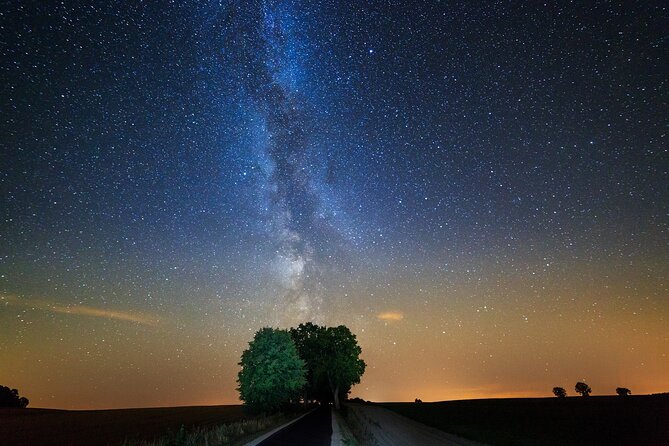
Sedona’s red rocks are famous by daylight, but this tour turns your attention upward. Guide Chad uses a laser pointer, planisphere, Play-Doh Milky Way, and other visual aids to connect Greek constellation myths and local Indigenous star associations with the stars you can see without a telescope. I like the practical focus on learning the sky with your own eyes, and I like the unusual mix of astronomy, storytelling, humor, and Sedona lore.
The main thing to understand is that this is not a telescope session built around one spectacular view through an eyepiece. It is a seated, two-hour presentation with time spent looking up, listening, and joining in. Chad’s energetic style wins many people over, but some find the talk too long, repetitive, or story-heavy.
Key details before you book
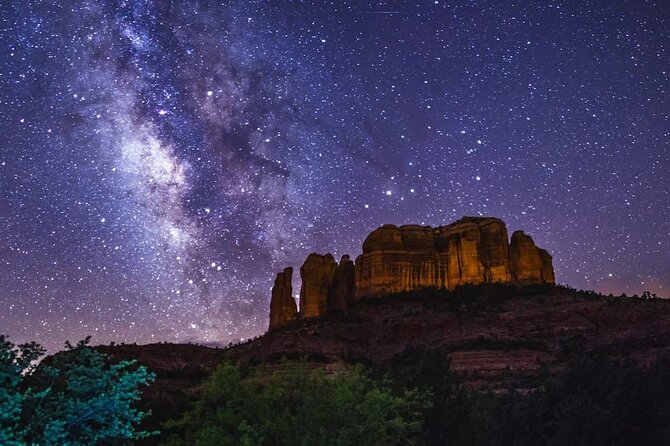
- Naked-eye astronomy: You learn how to recognize stars and constellations without depending on a telescope.
- Chad’s animated presentation: The guide brings years of Sedona guiding and night-sky experience, with plenty of humor and audience participation.
- A changing seasonal sky: Orion, Sirius, Cassiopeia, Leo, Gemini, Taurus, the Pleiades, Jupiter, Saturn, and the Big and Little Dippers may appear, depending on the date.
- Comfort in cool weather: Chairs, blankets, and hand warmers are provided, but you should still dress warmly.
- Small-group setting: The maximum is 15 people, so the format can feel more personal than a large bus excursion.
- Weather flexibility: If clouds spoil the sky, you may request a full refund, even after staying for the program.
What this Sedona night-sky tour is really about
At $100 per person, this experience is priced more like an evening educational program than a simple stargazing stop. That matters because the value depends on what you want from the night.
If you want an instructor to help you understand how the sky works, why constellations move, and how different cultures gave meaning to the same stars, the price can make sense. You are paying for a prepared presentation, visual materials, a seasoned local guide, and two hours of structured attention.
If your ideal evening means lying quietly under a dark sky and watching for shooting stars, you may find this too talkative. One critical experience described the program as more lecture than hands-on observation. That is a fair caution. The tour includes star viewing, but the central activity is Chad’s presentation.
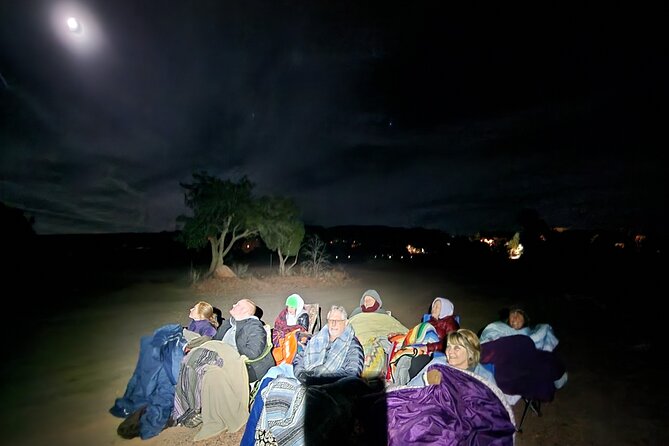
The format is simple. You meet at 77 Cultural Park Place in Sedona at 7:30 pm, remain in one location, and return to that same meeting point when the session ends. Chairs are supplied, so you do not need to sit on the ground. The group can include couples, families, solo participants, and friends, with a maximum of 15 people.
More Milky Way Tours in the USA:
- Stargazing and Milky Way Portrait in Capitol Reef National Park
★ 4.5 · 13 reviews - Milky Way Photography Workshop in Acadia National Park
★ 5.0 · 8 reviews - Milky Way Photography in Arches National Park
★ 4.0 · 4 reviews
Meeting Chad, the guide behind the show
Chad has lived in the Sedona area since 1996 and began professional guiding in 2005. He has led thousands of tours and has spent more than six years conducting night-sky programs.
His background shapes the tone. This is not a quiet, strictly academic astronomy class. Chad is also a musician, actor, dancer, athlete, and storyteller, and he brings that performance energy to the session. Expect movement, jokes, questions, audience participation, and explanations aimed at making large ideas easier to grasp.
I would describe his style as lively and personal. Many parts of the experience depend on whether you enjoy an instructor who is highly animated and willing to make himself part of the story. Families and curious first-time sky watchers may appreciate that energy. People who prefer a restrained, technical lecture may need more patience.
The guide also connects the night program with his daytime Experiential and Scientific Vortex Tour. You do not need to take that other tour, but the evening includes some of the same ideas about Sedona, place, and the way people interpret their surroundings.
Greek myths, Indigenous associations, and the stories overhead
The storytelling is the heart of the experience. Chad links familiar constellations to Greek and Roman mythology, then broadens the discussion to local Indigenous associations with the stars.
That cultural comparison gives the evening more meaning than simply memorizing shapes. A constellation is not a fixed picture in the sky in the same way for every culture. Different communities saw different figures, lessons, animals, ancestors, and signs in the same collection of stars.
You may hear stories connected with Orion, Taurus, Gemini, Leo, Cassiopeia, and other familiar figures. The precise lineup changes with the season, but the point remains the same: the night sky has served as a record of stories and ideas for thousands of years.
The tour also uses pop culture references, music, and everyday comparisons. That can help if school science never made the stars feel approachable. It can also make the experience less formal and more conversational.
One useful strength is audience participation. You are encouraged to ask questions and take part rather than simply sit through a memorized speech. Still, the presentation can feel dense. If you already know Greek mythology or basic astronomy, some sections may seem familiar, while the local cultural material and broad cosmic perspective may be newer.
The big-picture astronomy lesson
Chad’s astronomy approach concentrates on what you can understand from Earth. He describes our planet as Spaceship Earth moving through the solar system and galaxy, then uses the visible sky to explain larger ideas.
The best part of this approach is scale. The stars can seem like a flat ceiling, but the program helps you think about distance, motion, perspective, and the changing position of objects overhead. One especially useful topic is the difference between the apparent fast and slow movement of stars, an idea that several parts of the experience are built around.
You will not need a telescope to take something home from the evening. The goal is to help you recognize patterns and understand the motion of the sky with your own eyes. That knowledge remains useful after the tour, including on a later night when you are standing outside without special equipment.
A large-screen star app is used at one point, along with the laser pointer and physical teaching aids. There is a slight tension here. The tour promotes naked-eye observation, but some people would prefer seeing the star map first, then looking up to find the pattern. If you learn best through a clear visual sequence, pay attention to this potential weakness.
More Stargazing Tours around the USA:
- Small Group Big Island Twilight Volcano and Stargazing Tour
★ 5.0 · 1,619 reviews - Griffith Observatory Hike: Guided Tour through Griffith Park
★ 5.0 · 1,020 reviews - Sedona Stargazing Tours LLC
★ 4.5 · 881 reviews - Los Angeles: Hollywood Night Tour with Griffith Observatory
★ 4.2 · 531 reviews
The visual aids make abstract ideas easier
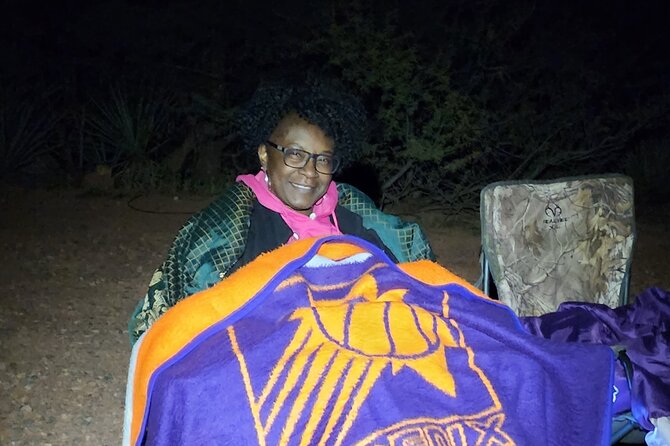
The Play-Doh Milky Way is one of the more distinctive teaching tools. It gives the group a physical way to think about the galaxy rather than treating it as a flat glowing band.
The planisphere serves a more practical purpose. It helps connect date and time with the part of the sky you should expect to see. The laser pointer then directs your attention to specific stars and constellation shapes.
These tools matter because pointing at the sky can be frustrating. A guide may indicate a constellation, but until your eyes and brain recognize the pattern, you may see only scattered points of light. Visual aids give you a bridge between the explanation and the real sky.
The method is not perfect for everyone. Two experiences specifically wanted the constellation app or video shown earlier and felt that the presentation became hard to follow. If you are new to star charts, ask questions and keep your expectations realistic. You are learning a system, not simply being shown a list of bright objects.
What you might see during the two hours
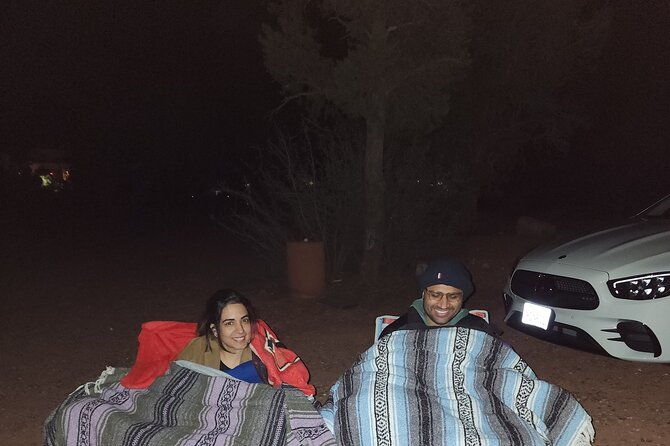
The stated highlights include Orion, Sirius, Cassiopeia, Leo, Gemini, Taurus, the Pleiades, Jupiter, Saturn, the Big Dipper, and the Little Dipper. The actual view depends on season, time, cloud cover, and local conditions.
A no-moon evening can be especially helpful because moonlight does not wash out as many faint stars. At other times, a bright moon may change what is visible. Planets also appear at different times of year, so you should not assume every object listed will be overhead on your date.
The best sessions can include the Milky Way, shooting stars, and a dense spread of visible constellations. One clear evening produced 11 shooting-star sightings for a couple. That is a delightful possibility, not a promise.
This is why I would treat the sky itself as a bonus and the instruction as the dependable part of the booking. A clear night may give you an impressive view of the Milky Way. A partly cloudy night may still provide a good storytelling session, but the direct observing will be limited.
Staying warm at the Sedona meeting point
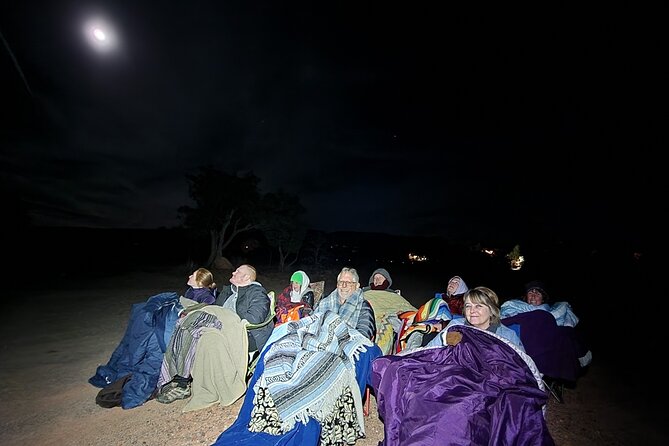
Sedona nights can turn cold, especially in winter. The supplied blankets and hand warmers are more than a minor extra. You remain outside for about two hours, and sitting still makes the cold more noticeable.
Bring warm layers, gloves, and a stocking cap during the colder months. The guide provides comfort items, but those supplies are meant to help, not replace proper clothing.
You should leave pets and alcohol at home. Service animals are allowed. Most people can participate, and the meeting point is near public transportation, although the supplied information does not describe a specific transit route or parking arrangement.
Because you stay in one place, there is no walking route to prepare for. That makes the program easier for anyone who prefers a stationary activity after a day of hiking. It also means you will not get changing views or the sense of moving through several scenic locations.
Cloudy weather and the unusual refund option
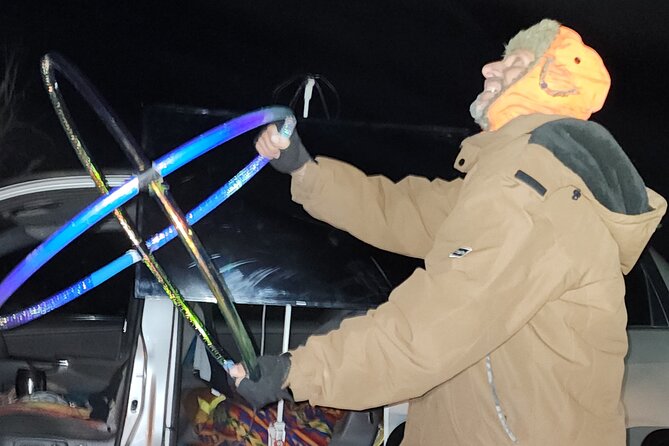
Clouds are the biggest variable. Sedona is generally dry, but clear skies are never guaranteed. A cloudy evening can reduce the star viewing to almost nothing, though the guide may still offer stories and astronomy concepts.
This tour has an unusually generous weather arrangement. If the sky is cloudy, you may cancel for a full refund at your discretion, even within the normal 24-hour cancellation period. You may also remain for the entire program and still request a refund.
That policy reduces the financial risk of booking around a weather forecast. The practical choice is to give the evening a chance, since clouds may move away before or during the tour. If they do not, you are not locked into paying for an experience that failed to provide the sky you came to see.
For ordinary cancellations, you need to cancel at least 24 hours before the 7:30 pm start for a full refund. If the operator cancels because of poor weather, you are offered another date or a full refund.
Who will enjoy this most
I would recommend this tour to you if you like stories, cultural connections, and explanations that go beyond naming a constellation. It suits adults who want to understand the sky and families with children who respond well to a lively presenter.
It can also work well for solo visitors. The small group and participation-based format give you a natural way to join the discussion without needing to arrive with companions.
You should think twice if you want a silent stargazing session, a professional observatory, or a telescope-centered program. You may also find the presentation too long if you prefer short explanations followed by long periods of independent viewing.
The experience is best for people who enjoy learning through personality. Chad’s enthusiasm is a central part of the evening, not a side detail.
Is $100 a fair price?
The price is fair if you value instruction and a prepared program. You receive about two hours with an experienced local guide, a small-group setting, seating, blankets, hand warmers, a laser pointer, a planisphere, and several visual demonstrations.
The price is less compelling if you are mainly paying for darkness and stars. You can look at the night sky without a ticket, and clouds or seasonal conditions may limit what you see. The tour’s added value comes from knowing where to look, understanding what you are seeing, and hearing the stories attached to it.
I would also consider the timing. This makes a pleasant end to a day of hiking or sightseeing because you remain seated rather than adding another strenuous activity. The evening ends back at the starting point, so it is easy to treat it as one contained part of your Sedona plans.
Should you book the Night Sky Star Story, Galaxy, and Sedona Story Tour?
Book it if you want an animated guide, mythic stories, local Indigenous star associations, and plain-language astronomy tied to the actual sky above Sedona. Chad’s energy, the laser pointer, the unusual visual aids, and the weather refund policy give the experience real appeal.
Skip it if you expect telescope viewing, a quiet meditation under the stars, or a short technical briefing. Before booking, check the forecast and seasonal sky, then arrive dressed for cold weather.
For the right audience, this is a memorable way to learn the night sky. You may leave with more than a photograph. You may be able to look up later and know what you are seeing.
FAQ
Where does the tour begin?
It begins at 77 Cultural Park Place, Sedona, Arizona 86336.
What time does the tour start?
The scheduled start time is 7:30 pm.
How long does the experience last?
The tour lasts approximately two hours and five minutes.
Does the tour use a telescope?
No. The program focuses on what you can see with your own eyes. It uses a laser pointer, planisphere, Play-Doh Milky Way, star app, and other visual aids instead.
Who leads the tour?
The tour is led by Chad, a Sedona guide who has conducted professional tours since 2005 and has offered night-sky tours for more than six years.
What constellations or objects might I see?
Possible highlights include Orion, Sirius, Cassiopeia, Leo, Gemini, Taurus, the Pleiades, Jupiter, Saturn, the Big Dipper, and the Little Dipper. Visibility changes with the season and weather.
Are chairs and blankets provided?
Yes. Chairs, blankets, and hand warmers are provided. You should still dress warmly, especially during colder months.
What happens if the night is cloudy?
You may request a full refund at your discretion if the night is cloudy, including after staying for the entire program. If the operator cancels because of poor weather, you can choose another date or receive a full refund.
How many people can join the tour?
The maximum group size is 15 people.
Can I cancel my booking?
You can cancel at least 24 hours before the start time for a full refund. Changes or cancellations made less than 24 hours before the start time are not accepted under the standard policy, except for the special cloudy-weather arrangement.
Just in after dark around the USA
- Seattle: Hop-on Hop-off Bus Tour and Sky View Observatory★ 4.4 · 16 reviews
- Boulder: Guided Astronomy Tour★ 4.7 · 11 reviews
- 1-Day Grand Canyon Tour from Las Vegas: Stargazing & Sunrise★ 3.6 · 3 reviews
- Griffith Observatory: Scott E-Bike Tours LA Private Tour★ 5.0 · 32 reviews
- Private Tour of Griffith Observatory★ 4.5 · 58 reviews
- Stargazing and Milky Way Portrait in Capitol Reef National Park★ 4.5 · 13 reviews
- Haleakala Sunset and Stargazing Audio Tour★ 4.0 · 10 reviews
- Stargazing Tour in Kapalua★ 5.0 · 31 reviews
Milky Way Tours, night against night.
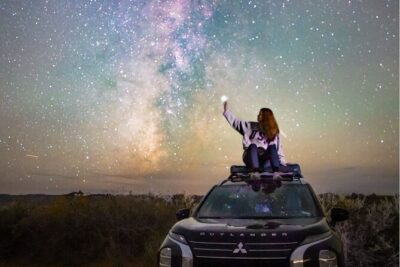
Stargazing and Milky Way Portrait in Capitol Reef National Park
Read our review →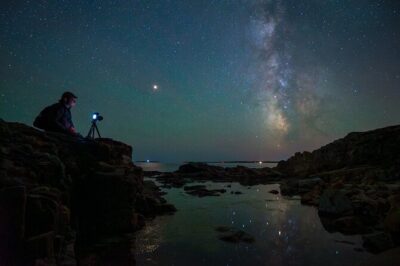
Milky Way Photography Workshop in Acadia National Park
Read our review →
Mount Bromo Milky Way Photography and Sunrise Private Tour (1D1N)
Read our review →
Lists this night appears in