
Review · TENERIFE
Tenerife: Teide Stargazing with an Astrophysicist
Teide National Park gives this stargazing outing a serious advantage: you are already high in the mountains, beneath a famously clear sky, with far less light around you than on Tenerife’s coast. The 8-inch telescope can reveal details that your eyes alone will miss, from Moon craters and planets to star clusters and nebulae.
I like the small group of no more than 10, and I like the way guide Adal explains the telescope instead of treating it as a mysterious black box. He has a lively style, welcomes basic questions, and can adjust his explanations for children, beginners, and keen amateur astronomers.
The catch is the mountain weather. Temperatures can fall to 0 to 4 C from October to March, and even summer evenings can be cool at 10 to 15 C. You also need your own car or a taxi, and poor conditions can lead to a cancellation.
Key points at a glance
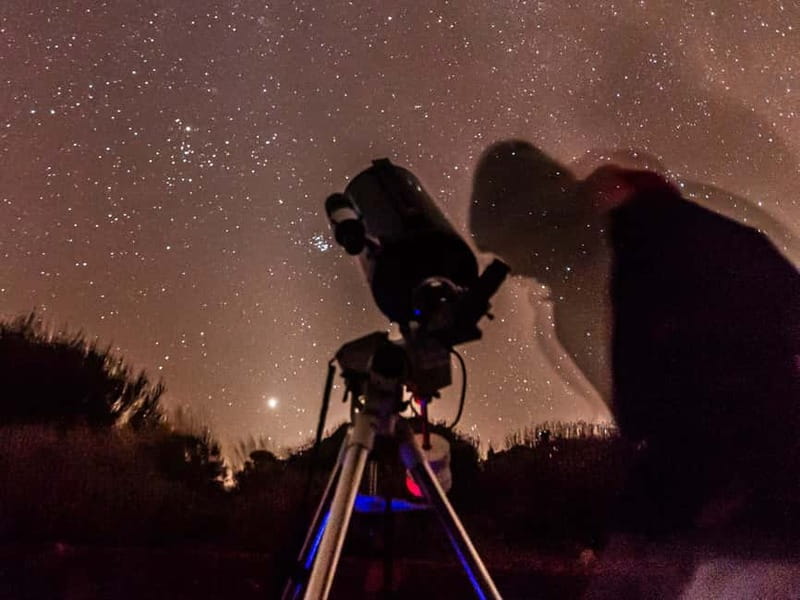
- A real 20 cm telescope: The 8-inch instrument can show planets, Moon craters, star clusters, nebulae, galaxies, and binary stars when conditions cooperate.
- Adal’s astronomy lessons: The guide combines astrophysics, constellation stories, science history, and humor rather than simply pointing at the sky.
- A genuinely small group: With a maximum of 10 people, you should get a clear view through the telescope and room to ask questions.
- A high-mountain meeting point: The tour begins and ends outside the Parador de Cañadas del Teide, not at a coastal resort or city viewpoint.
- Only 90 minutes: The compact format suits a wider Tenerife itinerary, though serious astronomy fans may want a longer private session.
- Weather decides the evening: Bring warm layers and keep your plans flexible in case mountain conditions make the activity unsafe.
Why Teide is such a good place for stargazing
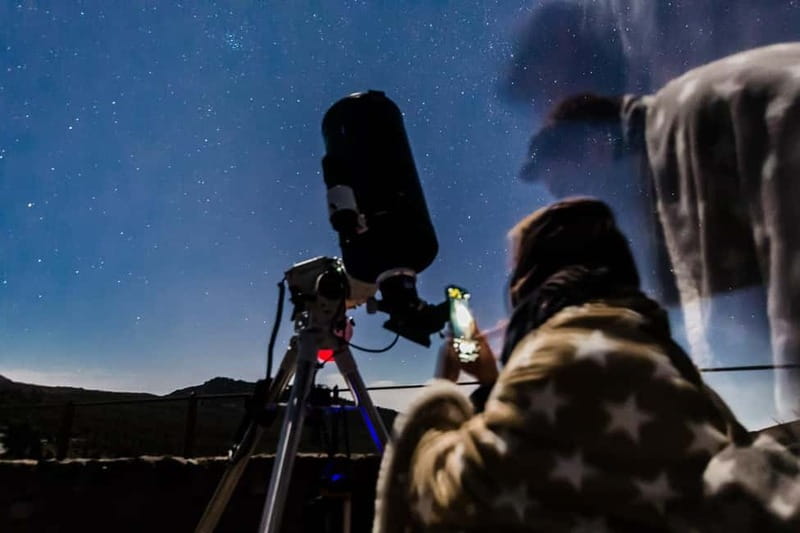
At night, Teide National Park feels far removed from the resort towns below. That matters because artificial light can wash out faint stars and make telescope viewing less satisfying. Here, the setting gives you a much better chance to see a crowded field of stars with your unaided eyes before the telescope adds another layer of detail.
The meeting point is the entrance and outdoor patio of the Parador de Cañadas del Teide. This is practical, but it is not a door-to-door excursion. You must reach the hotel yourself, so this experience works best if you have a rental car or have arranged a taxi in advance.
The high elevation is both the reason the sky is so appealing and the reason you need to prepare. Mountain air can feel sharply cold after sunset, even if you spent the day in warm coastal weather. Wear proper shoes, thermal layers when needed, and a jacket that you will be happy to keep on while standing outside.
You should also bring water. Food and drinks are not included, and the activity is short enough that most people can manage without a meal during the session. Still, plan ahead, especially if you are driving up from the coast and will be away from normal shops and restaurants.
More Stargazing Tours around Tenerife:
- Tenerife: Teide National Park Sunset & Stargazing Tour
★ 4.2 · 3,812 reviews - Tenerife: Sunset and Stargazing at Teide National Park
★ 4.7 · 2,826 reviews - Teide National Park Sunset & Stargazing with Dinner (Star Safari)
★ 5.0 · 2,601 reviews
Meeting Adal beneath the night sky
The guide is a central part of this experience. Adal is an official certified guide with astrophysics training, and the strongest part of his approach is his ability to speak at different levels. You can arrive knowing almost nothing about astronomy and still follow the session. If you already know the basics, you can ask more detailed questions.
He explains the equipment, the objects in the sky, and the ideas behind them in a friendly way. Basic questions are welcome, which is important in a subject that can otherwise feel intimidating. His humor and enthusiasm help keep the session from turning into a dry lecture.
The language is English or Spanish, with regular sessions described as single-language groups. That is worth checking when booking, since a single-language presentation is easier to follow than a mixed-language talk that switches back and forth.
The group limit of 10 is another practical strength. Everyone will not be looking through the eyepiece at the same moment, but a small group makes the waiting time reasonable and gives you a better chance to hear the explanation. It also feels more like a guided lesson than a crowd gathered around a public telescope.
What happens during the 90-minute session
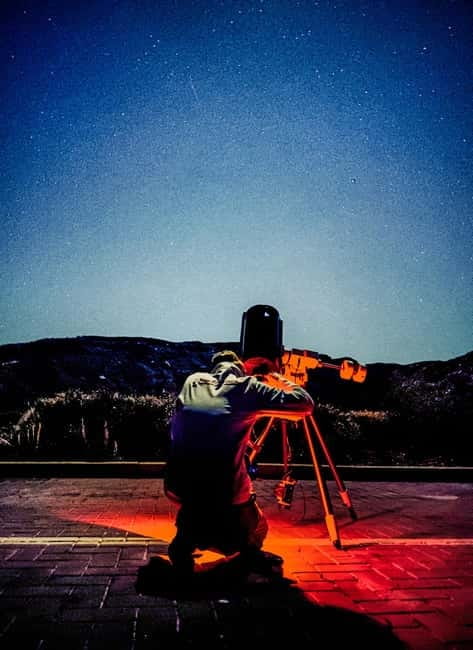
The activity starts and finishes at the Parador. There is no separate transfer, hike, or restaurant stop built into the 1.5-hour program. That makes the plan simple: arrive at the patio, meet the guide, spend the session outdoors, and return to the same point.
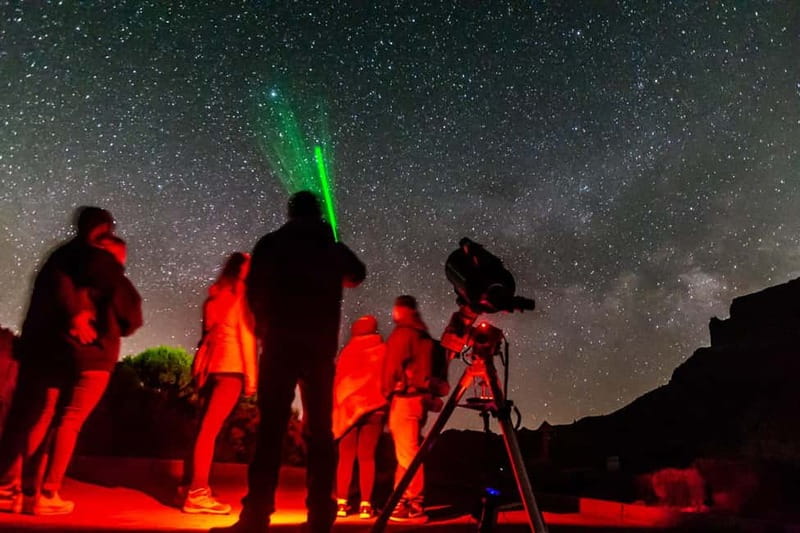
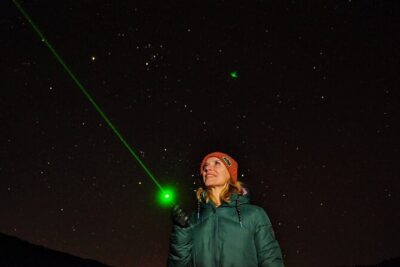
The guide uses a lantern and laser pointer to help orient the group. The laser-guided explanation is useful at the beginning, when the sky can look like a mass of scattered lights. Instead of seeing only stars, you learn to connect them into constellations and understand which patterns have shaped stories and myths.
The exact objects you see will depend on the date, the Moon, cloud cover, and what is visible at that time of year. This is important: no responsible astronomy tour can promise a fixed list of planets or galaxies. On different evenings, people have viewed Jupiter, Saturn and its rings, Neptune, the Moon and its craters, star families, false binary stars, nebulae, and a galaxy.
That variety is part of the appeal. A bright Moon may make some faint deep-sky objects harder to see, but it can give you a fine look at craters and surface detail. A darker night may offer better views of faint star clusters, nebulae, or a galaxy. The guide adapts the program to the conditions rather than forcing a rigid script.
Seeing more through the 8-inch telescope
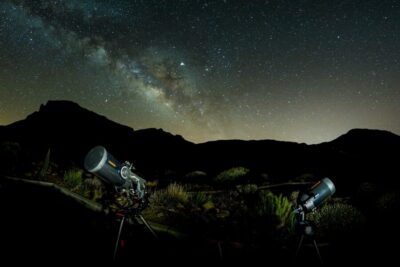
The included telescope is a professional 8-inch, or 20 cm, instrument. That is large enough to show much more than a casual pair of binoculars, while still being manageable for a small guided session.
You may see a planet as a distinct world instead of a bright point. Saturn can reveal its rings, and Jupiter may appear with some of its moons. On suitable nights, the Moon’s craters become clear and sharply defined.
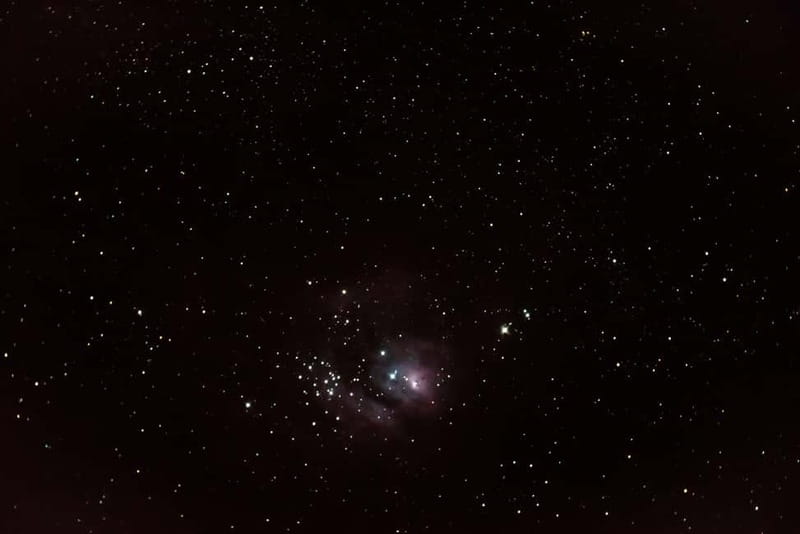
The telescope can also show objects that are hard for beginners to identify. A star cluster may look like a dense spray of lights. A nebula can appear as a pale cloud. A galaxy may be a faint smudge rather than the dramatic spiral image you have seen in books. That difference is worth understanding before you arrive. The experience is about seeing real objects with your own eyes, not viewing colorful long-exposure photographs.
The session can also cover binary stars and false binary systems. These are useful examples because they show that the sky is not just a collection of isolated points. Some stars appear close because they are linked, while others only look paired from our point of view.
Adal also explains how the telescope is set up and how it works. I consider this a major value point. You are not simply placed in line and told to look. You get a clearer idea of how amateur astronomy equipment finds and magnifies distant objects.
Same stars, another vantage point:
- Teide National Park: Sunset & Stargazing Safari with Dinner
★ 4.6 · 2,115 reviews - Teide by Night: Sunset & Stargazing with Telescopes Experience
★ 4.5 · 1,492 reviews - Teide: Guided Sunset & Stargazing Tour by Night with Dinner
★ 4.7 · 1,339 reviews - Sunset & Stargazing Experience From Teide
★ 4.5 · 1,129 reviews
Constellations, myths, and the science behind the view
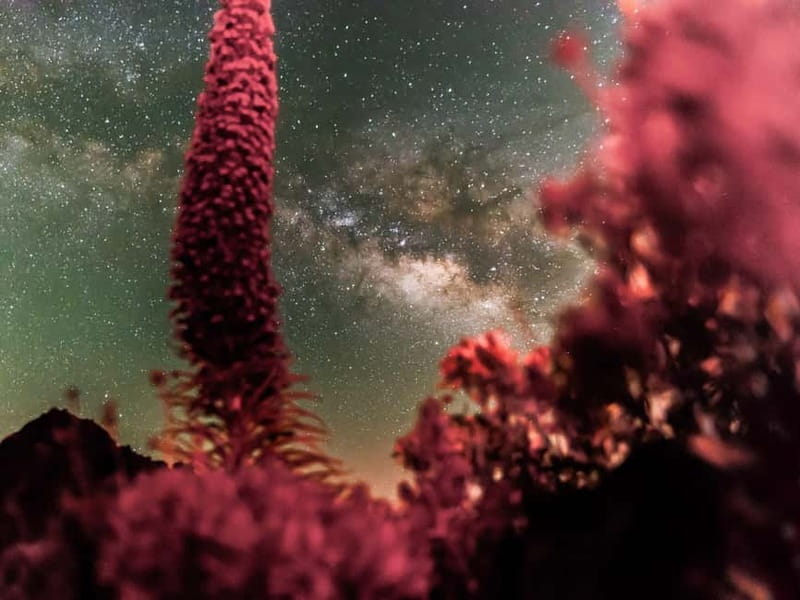
The session has two tracks running at once. One is visual: find a constellation, aim the telescope, and look at an object. The other is educational: understand how astronomers study the universe and how people through the ages have made sense of the stars.
The constellation stories add an accessible human element. You do not need any astronomy background to enjoy them, and they give you a useful way to remember what you saw. The guide also covers the history of science and astronomy, along with current astrophysical research.
That balance works well for a mixed group. A family can enjoy the stories and the telescope. A curious beginner can leave with a better grasp of stars, planets, and galaxies. An experienced amateur can use the question period to ask about equipment or the objects visible that night.
The activity is not a formal university lecture, and you should not expect advanced technical instruction for the entire 90 minutes. Its strength is the mix of clear science, direct observation, and entertainment. You learn enough to make the sky feel more understandable without losing the pleasure of simply looking up.
How much value do you get for $47?
At $47 per person, this is not the cheapest evening activity in Tenerife, but it offers more than a basic viewpoint stop. The price covers a trained astrophysicist, a certified guide, a small group, a laser-guided presentation, a lantern, and use of the 8-inch telescope.
The value is strongest if you care about explanation. You could drive into Teide National Park and look at the stars on your own, but you would not necessarily know what you were seeing or how to find it. You might spot a bright planet without knowing which one it is, or mistake a star cluster for a faint cloud.
A guide also helps you get more from a short visit. In 90 minutes, you can move from orientation and constellation stories to telescope viewing without spending the evening working out equipment and star charts yourself.
The price feels less worthwhile if you expect transport, dinner, or a long astronomy workshop. None of those are included. You pay for the sky interpretation and telescope time, not for a full evening package.
Private sessions are available on other days, though the supplied details do not give a private-tour price or duration. If you want more control over the objects discussed or need a schedule outside the regular Tuesday and Friday sessions, ask about that option before booking.
Family suitability and the cold-weather question
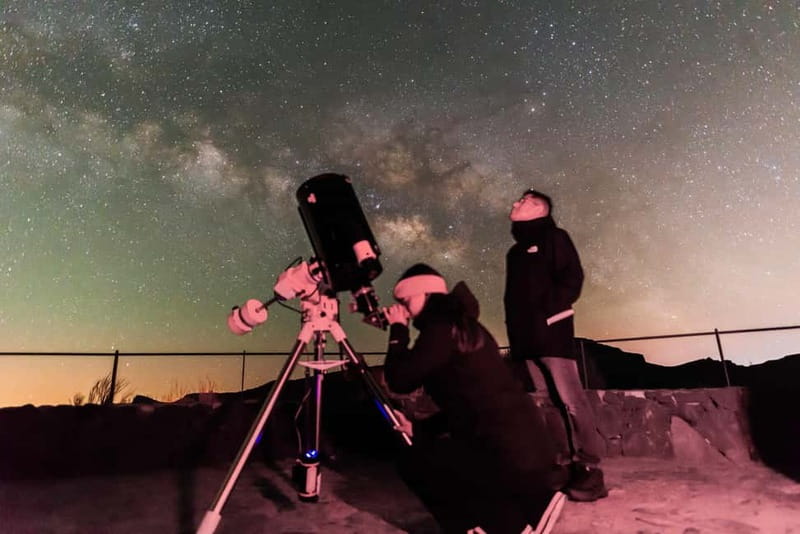
The activity is aimed at children around eight and older. The high mountain conditions may not suit children under seven to nine, and the formal restrictions say it is not suitable for children under eight or babies under one.
For older children, the telescope can turn astronomy into a direct experience. Looking at the Moon’s craters or a planet is easier to remember than hearing a general explanation indoors. The guide’s ability to explain ideas at different levels also helps families with children and adults who have different interests.
Still, do not treat this as a warm, seated show. You will be outside, likely standing for much of the session, and temperatures can drop quickly. Young children who struggle with cold or late evening schedules may not enjoy it, even if they like space.
Comfortable shoes matter because you are at a mountain site. Warm shoes and thermal clothing are sensible from October through March. From April through September, the stated range is 10 to 15 C, which can still feel cold after dark. Bring more clothing than you think you need.
Weather, cancellations, and planning around the tour
Mountain weather can change the plan. The activity may be canceled for safety if conditions on the mountain are poor. In that case, you receive a full refund from the provider.
One cancellation described a Friday evening session called off on the morning of the tour because of conditions at the top of the mountain. The refund reached the customer’s card the following weekend. That example shows both sides of the policy: the cancellation can be disappointing, but a high-altitude night activity should not go ahead when the conditions are unsafe.
You can cancel your own booking up to 24 hours in advance for a full refund. Cancellations within the last 24 hours do not receive a refund, according to the stated terms. Reserve and pay later is available, which helps if you are still arranging your Tenerife schedule.
I would avoid placing this tour on the final night of your holiday if seeing the stars is a top priority. A weather cancellation is easier to absorb when another evening remains available. Also, keep your phone and email accessible on the day in case the provider needs to update you.
Who will enjoy this experience most?
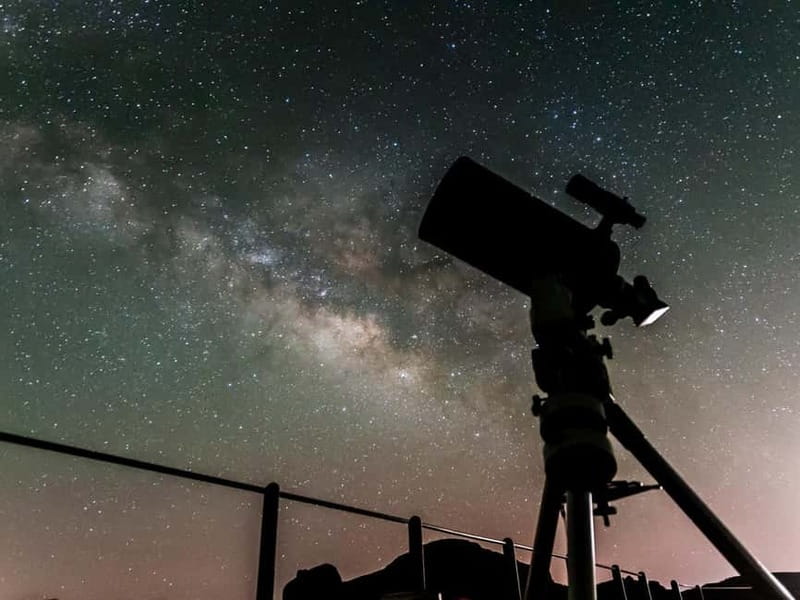
This is a good match for couples, solo visitors, families with older children, and anyone who wants more than a scenic drive through Teide National Park. It works especially well for first-time astronomy participants because the explanations start with the basics and build from there.
You will get the most from it if you are happy to stand outdoors, ask questions, and accept that the exact viewing list depends on the sky. The small group also suits people who prefer a quieter, more personal format.
Serious amateur astronomers may want to ask about the private option. A 90-minute public session cannot cover every area of astrophysics or provide unlimited telescope time. Still, the equipment and the guide’s background make the regular tour more substantial than a simple constellation talk.
This is less suitable if you need hotel pickup, want a full meal included, or prefer a warm indoor attraction. It is also a poor fit for very young children and anyone unwilling to bring serious cold-weather clothing.
Should you book the Teide stargazing tour?
Book it if you want a compact, well-explained introduction to the night sky in one of Tenerife’s strongest settings for stargazing. The best reasons are the small group, the 8-inch telescope, and Adal’s friendly way of making astrophysics understandable without watering it down.
Go in with realistic expectations. The sky may not cooperate, the temperature may be near freezing, and the view through a telescope is not the same as a space photograph. But if you arrive prepared, you can leave knowing how to recognize more of what you see above you, with a few memorable sights such as Moon craters, planets, clusters, or a nebula.
For $47, it is a fair buy for an educational night outdoors, provided you arrange your own transport and accept the weather risk. I would choose it for a curious family, a couple seeking a different evening, or a solo visitor who wants a local guide to make sense of the stars.
FAQ
Where does the stargazing tour begin?
It begins at the entrance and outdoor patio of the Parador de Cañadas del Teide Hotel in Las Cañadas del Teide, Santa Cruz de Tenerife.
How long does the activity last?
The guided stargazing session lasts 1.5 hours.
What languages are available?
The live guide is available in English and Spanish. Regular sessions are described as single-language groups.
Is transportation included?
No. You need your own vehicle or must arrange a taxi to reach the Parador meeting point.
What telescope is used?
The experience includes a professional 8-inch telescope, also described as a 20 cm telescope.
What should I wear?
Bring comfortable shoes, warm shoes, warm clothing, and weather-appropriate or thermal layers. Temperatures may be 0 to 4 C from October through March and 10 to 15 C from April through September.
Can the tour be canceled because of weather?
Yes. The activity may be canceled because of mountain weather conditions, and you receive a 100 percent refund if the provider cancels. You can also cancel up to 24 hours in advance for a full refund.
Just in after dark around Tenerife
- Magic Stargazing & Sunset in Teide with Dinner + Telescopes★ 3.5 · 20 reviews
- Private astronomy tour with sunset toast, picnic, and astrophotography★ 4.8 · 83 reviews
- Tenerife: Stargazing at Mt. Teide★ 4.2 · 72 reviews
- Mount Teide Night Tour: Stargazing, Dinner and Hotel Pick up★ 3.5 · 86 reviews
- Tenerife: Teide National Park Sunset Picnic and Stargazing★ 4.6 · 117 reviews
- Teide National Park: Stargazing Experience★ 5.0 · 118 reviews
- Tenerife: Mount Teide Observatory Astronomical Tour★ 4.4 · 126 reviews
- Self Drive Sunset & Stargazing in Teide National Park – No Dinner★ 5.0 · 151 reviews
Stargazing Tours, night against night.
Dubai Red Dunes ATV, Camels, Stargazing & 5* BBQ Al Khayma Camp
Read our review →
Teide National Park Sunset & Stargazing with Dinner (Star Safari)
Read our review →
Sunset Camel Trek, Al Khayma Camp, Stargazing & BBQ
Read our review →
Overnight Safari, Dinner, Stargazing & Al Khayma Camp
Read our review →
Dubai Overnight Desert Safari, BBQ & Stargazing at Al Khayma Camp
Read our review →
Sunset Quad Bike, Camel w/ Opt Stargazing and BBQ
Read our review →Lists this night appears in